

Walt retired from HVAC work in the spring, and by the time the leaves turned I could recite his whole day back to him. Weather. Gas prices. Whether the gutters needed doing. What the grandsons ate for lunch. What I could not remember was the last time he asked me a question that did not have a practical answer bolted to it. Thirty-eight years of marriage and our talking had settled into a very comfortable, very narrow groove, and neither one of us knew how to widen it without making a production out of it.
So I went looking for something small. No counselor's office, no weekend retreat at a hotel that smells like a swimming pool, no deck of cards with instructions long enough to make Walt's eyes glaze over. Just a book we could leave sitting out. A Year of Us is a couple's journal built around one question a day, 196 pages of them, and we have been working through it since the cold weather moved in. What follows is the honest accounting. What it did. What it did not do. And which parts got on my nerves, because some of them did.
The Quick Verdict
A plain book of one-a-day questions that got my quiet husband talking more than anything else I have brought home. It is a starter, not a repair kit. Somebody still has to sit down.
Amazon Check Today's Price →One question a day is the entire trick
196 pages, about the size of an ordinary novel, built to live on a kitchen table instead of a shelf. That is the whole idea, and it is the reason it worked on us.
Amazon Check Today's Price on Amazon →How I've Used It
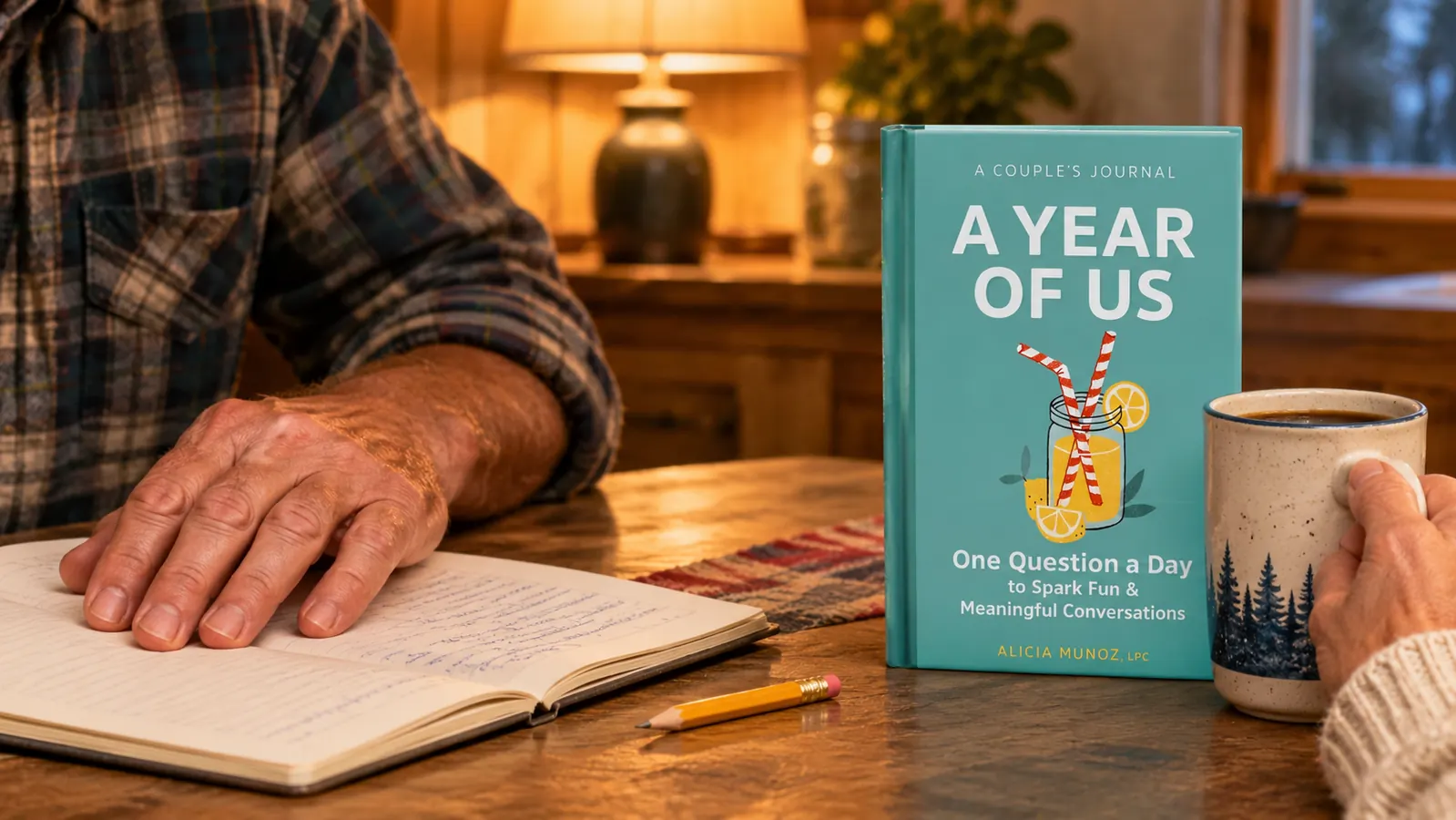
The book lives on the kitchen table, on the end nearest the window, between the salt shaker and Walt's reading glasses. That placement matters more than it should. If it had gone on a shelf it would still be on the shelf. After supper, once the dishes are in the rack, one of us opens it, reads the day's question out loud, and we both answer. Some nights that takes four minutes. Some nights it takes forty and I am still chewing on it while I brush my teeth.
Before the journal, I ordered a deck of conversation cards. Nice heavy stock, a little box, the kind of thing that turns up in a gift guide every December. I had it out on the table for most of a Sunday in October and it never got opened. The instructions ran three pages. There were categories, and a suggestion about drawing one at the start of a meal, and a note about not forcing it. Walt picked the box up once, read the back, set it down, and asked whether I thought the gutter needed doing before the rain. That is what a bad format does. It hands a man a reason to change the subject. The journal is quieter than that. One book, always open to the same page, nothing to set up and nothing to explain.
We started in November and we have not been perfect. We have missed days. We have missed a week here and there, once when Walt's back went out and he spent four days in the recliner pretending it was nothing, and once when I drove to Birmingham to stay with our daughter for eleven days after her surgery. I came home expecting the habit to be dead. It was not. The book does not scold you about a gap. You open it, you find where you left off, you go on. I had braced for the missed days to break the whole thing and they did not, which tells you how low the bar is set. Low enough that two tired people can clear it on a Tuesday.
Walt writes his answers with a pencil he keeps behind his ear out of long habit from the job. I use whatever pen is closest to the phone. That is the entire system. No app, no timer, no notification reminding us. Which is both the appeal and the limitation, and I will get to that.
What Is Actually Inside
It is a paperback, six inches by nine inches, which is about the size of an ordinary novel. The listing puts the thickness at just under half an inch and the weight at 2.31 pounds, which is heavier than a book that size sounds when you say it out loud, and it sits flat without taking over the table. Callisto published it in June of 2019. It runs 196 pages, it is in English, and it is part of a series of question-a-day journals. The premise is exactly what the title says. One question for each day. That is the whole architecture. There is no scoring, no twelve-week program, no chapter you have to finish before you are allowed to move on to the next thing.
I counted the pages the first week, which tells you something about me. If you do the arithmetic on one question a day against 196 pages you land somewhere in the back half of a year, which means we are nowhere near the end of it and the habit has somewhere to go. That mattered to me more than I expected. I have started plenty of things that ran out of runway in February.
I am not going to quote the questions at you. Partly because I would get the wording wrong and partly because not knowing what is coming is half of what makes it work. What I will tell you is the range. Some are light enough that Walt answers before I have finished reading the sentence out loud. Some are the kind that make the room go quiet and the refrigerator sound loud. Most sit in the middle, which is right, because a book that swings for the fence every single night gets exhausting by February.
I had braced myself for something syrupy. The cover copy promises fun and meaningful conversations, and that combination usually means a book that wants to be your therapist and your party host at the same time. A Year of Us is plainer than that. It asks, you answer, you close it. The writing is not showing off.
The Nights That Stuck
There was a night in January when the question was about the job he would have wanted if he had not gone into HVAC. Walt sat there long enough that I assumed I was getting the word fine. Then he told me he had wanted to be a surveyor. He had looked into it in his twenties, decided it was not the practical choice with a young family, and never brought it up again. Thirty-eight years. I had no idea. He is sixty-four years old and I learned something new about my husband at my own kitchen table in the middle of January.
Then there was a Sunday in February, the one where the question had to do with a trip we never took. We had talked about driving out to see the canyon in 1994, back before the kids were in school, and then the transmission went in the truck and that was the end of it. I answered first and said I had stopped thinking about it years ago. Walt said he had not. He said he still looked at the road atlas in the glove box sometimes. I got up and refilled both our coffees and did not say anything for a minute because I did not trust my voice. That night took about an hour and a half, and it was not the answer to the question so much as where the answer led, which is the thing I did not expect from a book with a question printed at the top of a page.
Not every night lands like that. Some answers are short and I am the one who has to push. Some questions get a shrug, and I have learned to let those go instead of turning them into a thing. The book does not mind. The next night is a fresh question and a clean stretch of page, and neither of us is carrying a grudge about the one that fell flat.
The pattern I noticed is that the lighter questions do the heavy lifting. Walt will answer a silly one without thinking about it, and then twenty minutes later, in the middle of something else entirely, he comes back to it. The easy door is what gets him into the room. If the book had opened with the big questions, he would have found something to do in the garage.
What It Changed, and What It Didn't
Here is what changed. We talk more in the ordinary stretches of the day, not only during the four minutes with the book. He asks me things now. Small things. Last week he asked what I thought about the neighbor's fence, which does not sound like much until you know that for the first year of his retirement the most I got out of him before noon was a weather report.
There is a second thing, and it is harder to describe without sounding like a greeting card, so I will put it plainly. We have started sitting on the screened porch again after supper when the weather is decent. We always liked that porch. We just got out of the habit of it somewhere in the years when the evenings were for paperwork and the news. Twice in March Walt carried both our chairs out there without being asked and set them at an angle to each other instead of side by side facing the yard. I noticed. I did not make a fuss about it. But I noticed.
Here is what did not change. He is still the quiet one. A book does not rewire a man who has spent forty years answering with a single word, and I would be lying if I told you otherwise. What it did was give him a place where a longer answer was expected, on a schedule, without anybody making a face about it. That is a smaller thing than some of the reviews suggest, and it has been worth more to me than I expected.
He wanted to be a surveyor. Thirty-eight years and I learned that at my own kitchen table in January.

Where It Fell Short
The gaps. We are not on the page that matches the calendar and I have stopped feeling bad about it. If you are the kind of person who needs a streak kept alive, this will bother you more than it bothers me, and you should know that going in. Nothing in the book reminds you. No timer, no nudge, no notification. Miss a week and it will not come find you.
The imbalance. Walt writes like a man filling out a work order, which is to say small and sideways, and there are nights when his answer is one line and mine is a paragraph. That is not the book's fault. But if you are picturing a tidy keepsake, adjust your expectations. Some of our pages look like two different people were arguing over a grocery list.
And there was a stretch in early March I want to be honest about, because it is the part the good reviews leave out. We went almost two weeks without opening it. Not because anything was wrong. Because the alternator went in my car, and Walt's sister came through town, and by the time the house was quiet again the book had a stack of mail sitting on top of it. Nobody was avoiding anything. Life just got in the way, and the book has no way to get itself out from under a stack of mail. I found it on a Thursday, moved the envelopes, and read that night's question out loud, and we picked right back up.
And the biggest one. The book does not do anything by itself. It sat on the table for four days before we opened it the first time, and if I had married a man less willing to humor me it might still be sitting there with a film of dust on it. A journal asks a question. Somebody still has to answer.
What I Liked
- One question a day is a low enough bar that two tired people can actually clear it
- Six by nine inches and just under half an inch thick, so it lives on the kitchen table without taking the table over
- 196 pages means we are not close to running out and the habit has somewhere to go
- The light questions do the real work. They get a quiet man talking before he notices
Where It Falls Short
- No structure to rescue you when you fall behind. The gaps are yours to manage
- A partner who answers in one line will keep answering in one line
- It is a starter, not a fixer. If the two of you are barely speaking, this is not the tool
- Nothing nudges you. Miss a week and the book will sit there quietly until you pick it up
Who This Is For
Couples who still like each other and have run out of anything to say that is not logistics. That sounds like a narrow group and it is not. If your conversations have shrunk to errands, weather and the grandchildren, this is aimed squarely at you. It also suits the household where one person is quiet and a little skeptical about this sort of thing. A Year of Us does not ask Walt to be good at talking. It asks him to answer one question while the dishes dry, and he can do that.
Who Should Skip It
If there is real damage, this is not the repair. A book of questions is not a counselor and I would not want anybody reading this to think I am claiming otherwise. If the two of you cannot sit in the same room without it going sideways, put the book down and go find a person who does that work for a living. Skip it too if you want a workbook with exercises and a plan and a place to track progress. This is a book of questions. That is all it is, and for us that was enough.
If your table has gone quiet, start with one question
196 pages, one a day, and it does not ask either of you to be good at this. It only asks you to sit down and answer.
Amazon Check Today's Price on Amazon →