

Walt and I have been married thirty-eight years. Somewhere in the last two of them, after he retired from HVAC work and I retired from the front office of a middle school, our talking shrank to a short list: the weather, the truck, the grandkids, and whether we needed anything from the store. That is not a crisis. It is just what happens when two people stop having separate days to report back on. So I bought Answer This, a couples game from The World Game, for one plain reason. It had rules and it had a winner. The first person to answer ten questions correctly takes the game.
I had already tried the other thing. Two years ago I bought a little box of conversation cards, the kind with soft questions printed on nice heavy stock, and we got through four of them before Walt started building a card house with the rest. The cards were fine. They just did not give him a job to do. The difference here is small and it matters: Answer This is a game first and a conversation second. You write, you guess, you keep score, and the talking happens while you are busy trying to win.
The Quick Verdict
A scored game that got my quiet husband talking without anyone asking him to. It is a starter, not a repair kit, and a starter is what we needed.
Amazon Check Today's Price →A game with a scorecard, which is the only kind my husband will sit down for
Answer This, from The World Game, comes with 150 question cards, six dry-erase boards and markers, and a rulebook you can read out loud in about two minutes. Two to six players, one to three couples. It works with two just as well as with four.
Amazon Check Today's Price on Amazon →How I've Used It
We have played it eight or nine times since February. On the screened porch while the light held, and at the kitchen table once the evenings turned cold. Most nights it is just the two of us, which the box supports, and one Sunday we played with another couple from our class at church, which it also supports. The box says two to six players and one, two or three couples, and that held up in practice. Four around a table worked about as well as two, though the guessing gets louder and the arguments get funnier.
We started on a Friday in the middle of February, the week a cold snap had kept us inside for four days running. I set the box on the kitchen table between the salt shaker and Walt's coffee and told him I had bought us a game. He said fine. In this house that is a yes. We played the first half of that game standing up, because neither of us thought to pull out a chair, and by the third card he had sat down and pushed his coffee out of the way to make room for the boards.
A full game to ten runs somewhere near an hour, sometimes a little longer once somebody starts defending a board. We rarely finish a whole game anymore. We usually stop around five and let it go, because the conversation has taken over by then and neither of us wants to interrupt it to keep score. That is not a knock on the game. It is the reason we keep pulling it back out.
The rest of the time it lives on the shelf in the hall with the dominoes and the Scrabble nobody plays. It goes back in the box clean and it stays there until we want it. That sounds like a small thing until you own a closet full of games that never go back together right.
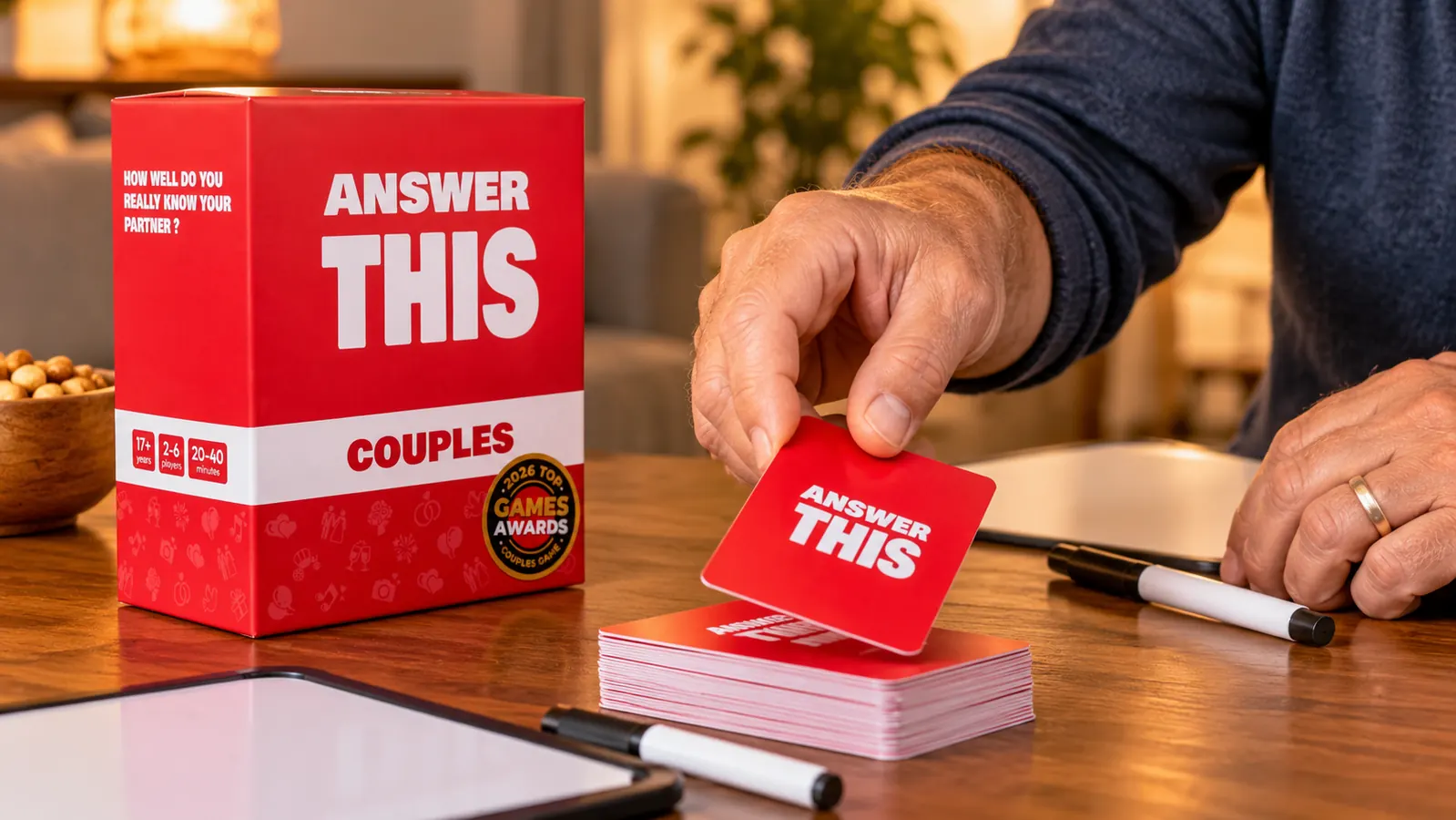
What Is in the Box, and Why It Matters
The box holds 150 question cards, six dry-erase boards, six markers and an instruction sheet. Six boards is why it stretches to three couples without anybody doubling up or sharing a lap. The board is the whole trick, honestly. Writing your answer down before anyone says it out loud keeps the fast talker from running the table, and I say that as the fast talker in this marriage.
Six boards is the part I underestimated. It means nobody shares and nobody waits, and the night we played with the other couple, all four of us had our own board and our own marker and the round moved at the speed of the slowest writer at the table, which is me. After two months of steady use our boards have not gone slick or stopped taking ink, and one pass with a damp paper towel takes a whole round of blue scribble off clean.
The markers that come in the box are small and they are not going to last you forever. Ours started skipping somewhere in the third month, and I bought a pack of fine-tip dry-erase markers at the drugstore to replace them. Cheap fix, and worth doing on the front end. The instruction sheet is one page, and it lays out the scoring in about six lines, so there is nothing to study ahead of time.
The box is marked for ages seventeen and up, and that is not a suggestion. These questions are written for adults who have been living real lives alongside each other. Nothing in it is crude and nothing made me blush, but it is not a game to hand the grandkids at Thanksgiving either. Read the box before you buy it for a young couple you do not know well.
How a Round Actually Goes
One of us draws a card and reads it out loud. Everybody writes an answer on their own board and keeps it covered. Then the guessing starts. You try to call what your partner wrote, and if you call it right, that is one step closer to your ten. First to ten correct takes the game. That is the whole engine, and it takes about one hand to learn. Nobody in this house needed the rulebook twice.
The questions run from easy to the kind that makes you set your pen down for a second. The easy ones are where Walt wins. He notices everything and says nothing, so he can call my answers all night long, which is the most flattering thing I have learned about him in a decade. The harder ones slow him down, and I have had to learn to stop filling the silence while he thinks. That took more practice than the game did.
One night in March a card asked what each of us thought the other would name as the best decision we ever made together. I wrote down the year we bought this house. Walt wrote down a week we spent in the mountains years ago with no itinerary and no reservations, a trip I had more or less forgotten, and which it turns out he has been carrying around for over thirty years. I got the point that round. I also got a story I had not heard in a decade, and I have repeated it at least four times since.
There is no app, no timer, no screen and nothing to charge. Somebody reads, everybody writes, and then you look at each other and guess. If your house is like ours and there is a television going in the other room, turn it off first. This does not compete with a screen and it is not built to. It wants the whole table.
The first round we ever played took us forty minutes because we kept stopping to argue about what counted as a correct answer. By the third evening we had it down to twenty. If you are the sort who needs the rules airtight before you start, read the sheet out loud once and then let it go. The game is sturdier than the rulebook makes it look.
What Changed at Our Table
Here is what I did not expect. It is not the card that gets you talking. It is the four minutes afterward, when the card has been answered and the board wiped and somebody says, wait, what did you mean by that. Twice we finished a round and never started the next one, because the last question opened something up that took the rest of the evening.
I will be straight with you, because I would want somebody to be straight with me. A card game does not repair anything. If there is a real hurt sitting between a husband and a wife, a scored game with whiteboards will not touch it, and it might make it worse. What this did for us was smaller and far more useful. It got us back in the habit of asking each other actual questions instead of trading the schedule.
After about a month, Walt started asking me things on his own, in the truck or out on the porch, with no cards anywhere in sight. I do not think that was the game's doing so much as it was the game reminding him he is allowed to be curious out loud. Either way it happened at our table and I will take it.
The change showed up in the small places, not the big ones. On a Tuesday in April, over supper, Walt asked me what I would have done differently in my last year at the school office. That is a thing I have never once brought up at this table. We talked about it until the plates went cold and nobody wrote a single word on a board that night. I do not think he could have asked me that question in January, and I am not going to pretend I know exactly why he could in April.
I also want to be honest about the size of this. Nobody is going to write a book about our Tuesday nights. But there was a stretch last winter where we ate supper in eleven minutes and watched something neither of us picked, and that stretch is over. For a box of cards, that is a decent return.

Where It Wore Thin
By the eighth or ninth evening we had started seeing cards we had already played. With 150 of them, that takes a while, and you can skip a repeat without any fuss. But the shine does come off somewhere around month three. Our fix was to put the game on the shelf for a few weeks and then bring it back out, which costs nothing and worked. We shelved it from the middle of April to the first week of May, and the cards that had gone stale in the winter felt new again.
A few cards land flat. Not wrong, just written for a couple with a different story than ours, and you sit there with an empty board while your husband looks at you. We skip those now without ceremony. There is nothing in the rules that says you have to play every card in the box, and I wish I had figured that out sooner than I did.
The scoring can also go sideways. Walt and I are both the youngest in our families and neither of us handles losing with any grace, so early on a small lead turned into a real argument about a board. We fixed it by not keeping score past five. A couple with a shorter fuse than ours should know that going in, because a game with a winner in it will find whatever competitive streak is already in the house.
What I Liked
- Got my quiet husband talking without asking him to talk
- Six boards and markers, so it works with another couple as well as with two
- 150 cards carried us through eight or nine evenings before repeats showed up
- A real score, which is the only reason Walt agreed to sit down
- Packs back into the box and wipes clean with a paper towel
Where It Falls Short
- Repeats start turning up after a dozen plays or so
- Some cards land flat and get skipped
- The included markers dry out, so plan on a replacement pack
- Keeping score can turn a touchy subject into an argument
- Marked seventeen and up, not a game for the grandkids
Walt lost by one point, and then kept talking for forty minutes after the cards went back in the box. Thirty-eight years, and a card game got more out of him in one evening than I did all last winter.
Who This Is For
This is for a couple who have run out of things to say that are not logistics. If your conversations have narrowed to the calendar, the weather and the children, Answer This will give you a running start. It is also good for two couples who already like each other and want an hour that is not another dinner out. The game is built by The World Game for a table, not a car, so plan on being somewhere everybody can write, with enough room to lay six boards out flat.
It suits people who like a game with a winner. That sounds like a small thing and it is the whole thing. If you would rather have a guided conversation with no points attached, this is going to feel like homework with a referee. The same goes for a couple who already talk easily. You will enjoy it, but you probably did not need it, and I say that with some envy.
Who Should Skip It
Skip it if there is real damage in the marriage right now. A scored guessing game is a terrible place to discover that you cannot predict a single one of your partner's answers, and I have thought about that a good deal since we started. That is a job for a counselor and a quiet room, not a box of cards on a Friday night.
Also skip it if you want deep questions only, all evening, with no laughing and no losing. This is a game. There are laughs in it and there are a few soft landings, but it is not a workbook and it is not pretending to be one.
One box, six boards, and an hour that is not about the weather
If your table has gone quiet, this is the simplest way I know to start it back up. The box from The World Game holds two to six players, ages seventeen and up, 150 cards, six dry-erase boards and markers, and a rulebook short enough to read out loud before the coffee goes cold.
Amazon See Answer This on Amazon →