

I have been married to Walt for thirty-eight years, and I can tell you the exact minute I realized I had gotten lazy about knowing him. It was a Tuesday in February. We were at the kitchen table, the one by the window where we eat when the porch is too cold, and I asked him what he had been thinking about all afternoon. He said the thermostat. Not a thought about the thermostat. The thermostat. Forty minutes of a grown man's inner life, and that was the entire report.
Walt is not a difficult man. He is quiet. He is the kind of retired HVAC technician who will spend a Saturday on a ladder for a neighbor and then say four words at supper. I knew that when I married him. What I did not expect was that retirement would shrink our conversation down to errands, the weather, and whatever the grandchildren did on their last visit. So I went looking for something to put on the table that was not a plate. I ordered Answer This, made by The World Game, mostly because the box called it a game and not another deck of questions. A game has a finish line. Walt will play anything with a finish line.
I should be honest about my expectations. I have bought a few of these over the years, the little tins and decks that get shuffled once and then live in a drawer next to the takeout menus. What got my attention here was the scoring. Somebody wins. That is a low bar for a product, I know, but it is the bar most of them fail.
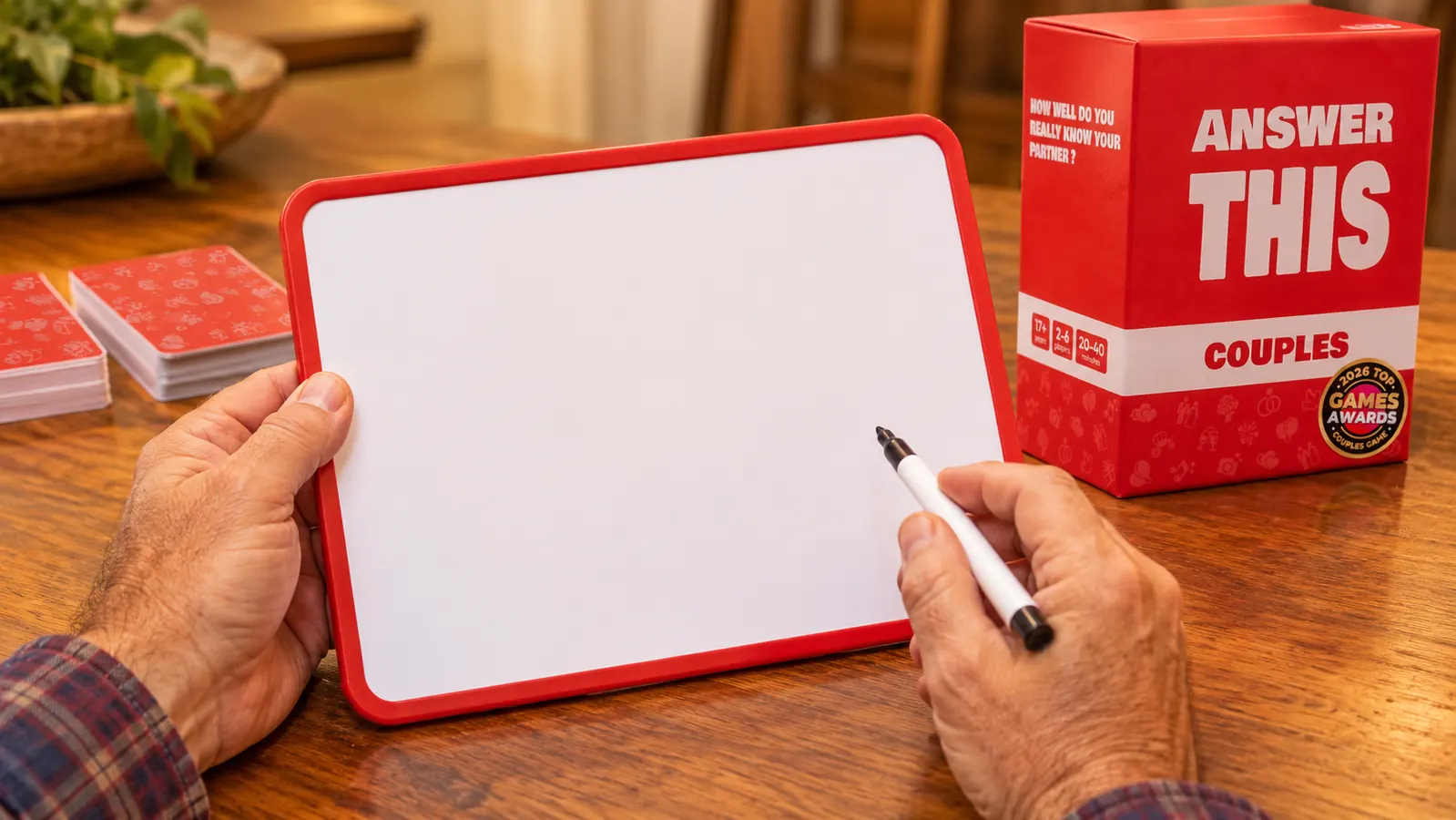
Here is what comes in the box: 150 question cards, six dry-erase boards, six markers, and a sheet of instructions. It plays two to six people, which means one to three couples, and it is rated for ages seventeen and up. The first player to answer ten questions correctly wins. That is the whole promise, and it is more of a promise than most of these things make.
I am not a counselor and I am not going to pretend a card game saved anything. What I will say is that after Walt retired we had more hours together and less to say in them than at any point in our marriage, and I did not care for the direction that was heading. That was the whole reason I went looking. I wanted something on the table that would make him reach a little.
The Quick Verdict
A real game with a real winner, which is exactly why it pulls a quiet husband into a two-hour conversation, and also why it can turn a pleasant evening into a scoreboard argument.
Amazon Check Today's Price →Two hours of Walt talking. That is the whole review.
150 question cards, six dry-erase boards and markers, and a winner at the end. Two to six players, ages seventeen and up.
Amazon See It on Amazon →How We Actually Play It
The first time, we played on a Saturday in October out on the screened porch, because that is where we live from April through November. I put the cards in the middle of the table, we each took a board and a marker, and Walt read the first question in the flat voice he uses for instructions. Then we both wrote. Then we turned the boards around, and about four seconds later I found out I had been wrong about something I would have sworn I knew.
Setup takes about a minute. There is nothing to download and no phone involved, which matters more to me at sixty-two than it did at forty. The boards wipe clean, the markers are still working after a few months of use, and the whole thing goes back in the box and onto the shelf by the porch door.
About the score. The instructions send you toward ten correct answers and a winner, and I believe they mean it. In our house we have never made it past five. Somebody writes something that does not match, and then somebody says hold on, what did you mean by that, and the next thing you know forty minutes are gone and nobody has touched the cards. I do not think we are playing it wrong. I think that is the game working, and then politely getting out of the way.
The evening I remember best was in November. A card asked something about first impressions, and we both wrote, and the answers turned out to be about two different nights entirely. He remembered the cookout where we met. I remembered a Tuesday two weeks later when he fixed the belt on my car in a parking lot and did not make a production of it. We sat there arguing, politely, about our own history, and neither of us was willing to give ground. That is worth the shelf space.
One warning about the shape of the night. It runs long if you let it. We have started setting the box on the counter at ten o'clock whether we are finished or not, because otherwise we will be up past midnight hashing out a question about somebody's high school years, and I have learned that nothing good happens at that hour.
The Boards Do More Than the Cards
Here is the part I did not see coming. The cards get the credit, but the boards are what make this work on a man like Walt. Talking is fast. He is not fast. Give him a marker and sixty seconds and he produces a better answer than he does in conversation, because he has had the chance to think it through without anyone watching his face while he does it.
The example I keep coming back to. At supper one night I asked him what he would change about our Sundays. He said nothing. Fine. The word he has handed me ten thousand times. A week later we were playing, a card landed in the same neighborhood, and he wrote down more of them with nothing on the list. I have thought about that line more than anything he has said to me in the last five years.
There is something about the marker itself, too. Handing a man a piece of plastic and asking him to write a sentence is less pressure than looking him in the eye and asking him to say one. He can cross it out. He can take his time. He wrote one answer, stared at it, wiped it away, and wrote something better, and I pretended not to be watching, which is a thing I am not good at.
It works on my side of the table as well. I am the talker in this marriage, and talkers have a habit of filling a silence before anyone else can use it. Writing forces me to wait. Some nights that has been the most useful sixty seconds I have spent all week.
What Nobody Tells You About the Scoreboard
Nobody mentions that keeping score changes the way you listen. Once there is a winner, you stop being curious and start being right. I caught myself doing it. Walt would be halfway through an answer and I would already be deciding what he was going to say, so I could take the point. That is a strange thing to do to your own husband at the kitchen table.
The misses turned out to be more useful than the hits. When I guessed wrong about him, I had to sit with the fact that my picture of him had gone out of date. He was wrong about me too, in ways I thought were obvious. Thirty-eight years and he did not know which of our two children I worry about more. In fairness, I did not know he had a preference either. We came out even and slightly humbled, which is a decent place to land on a Saturday night.
There is a small downside to that, and it showed up around the fourth game. Losing stings, even at sixty-two, even when the stakes are nothing but pride. Walt went quiet for a minute after I beat him, and I could see him deciding whether to be a good sport about it. He was. But you should know that the game can put a little weather in the room, and you want to be the kind of couple who can laugh it off.
So my advice is to keep score, because that is the game and the game is the reason he is sitting at the table in the first place. Then notice that the interesting part is not the number. The interesting part is the gap between what you wrote and what they wrote, and what that gap tells you about how long it has been since you last checked.
Where It Gets Awkward
The World Game sells this as an anniversary or engagement gift, and the questions lean younger than we are. Some cards are built for couples still assembling their history: the early dates, the first impressions, the getting-to-know-you years. At sixty-two, with thirty-eight years behind us, we have lived through those answers and the fun is more nostalgic than revealing. A handful of cards assume small children in the house or a recent move across the country. We skip those. Nobody is checking.
Adding a second couple changes the whole evening. Two to six players means up to three couples, and with other people at the table the game becomes a performance. You are answering about your own partner with an audience, and a little showing off creeps in whether you mean it to or not. It is a good time. It is also not the same private thing, so decide what kind of night you want before you send the text.
The bigger limit is the one nobody selling a card game is going to say out loud. It starts a conversation. It does not carry one. There is a version of this where a couple plays, has a fine hour, learns one small true thing, and is back to talking about the weather by Monday. The game cannot help that. Nothing in a box can. And if a marriage is genuinely in trouble, this is not the tool, and I would feel dishonest if I let the pretty packaging imply otherwise.
The one thing I would change is the count. Six boards and six markers come in the box, and for two people four of them will live in the box forever. Not a complaint, just the truth about a set that was built for a group.

What We Do With It Now
It lives on the shelf by the porch door, next to the deck we use for rummy and a flashlight that needs a battery. We play it maybe once a month, more in winter when the porch is closed up and the kitchen table is the only place to be. We do not play it on nights when one of us is tired or peeved. It is a fair-weather game in that sense, and I think that is the right way to use it.
The ritual we landed on is simple. One of us picks the night, the phones go in the other room, and we agree ahead of time that we are not going to have the serious conversation about the thing that has been sitting there all week until after we have played. By then we are already talking, and the hard thing is easier to say. That is not the game's doing, exactly. But the game is what gets us to the table.
What I Liked
- Everything is in the box, including the boards, so there is no prep and no phone on the table
- The dry-erase boards slow the conversation down, which is what a quiet partner needs
- It plays with two people or three couples, so it works for a Tuesday or a dinner party
- Walt answered out loud several things he would normally have dodged
- 150 cards means you will not run out in a single weekend
Where It Falls Short
- The scoreboard can turn a pleasant evening into a competition
- With two players, four boards and four markers sit unused
- Some cards suit newer couples better than a long marriage
- It opens a conversation and then stops. What you do on Monday is on you
Thirty-eight years in, and he was still wrong about me and I was still wrong about him. The gap between the two boards is the whole reason to play.
Who This Is For
Couples who have drifted into logistics. If your conversation has become a shared calendar with affection attached, this puts something else on the table. It suits a quiet partner especially, someone who needs a minute before he answers, because the board hands him that minute without anybody making a fuss about it. It works for a Tuesday night with nothing planned, and it works for two couples who want something to do besides watch a screen.
If your partner is the sort who says he is fine and means it, this will not hurt a thing. If he says he is fine and does not mean it, and you have both been letting that sit for a few years, this gives you a gentler way in than an ambush over the dinner dishes.
It is also a fair anniversary gift, with the caveat that it lands best with a couple who already likes to talk and just needs something to talk about. Give it to a couple who barely speak and it will sit in a drawer, which is not the game's fault.
Who Should Skip It
Skip it if you want a game with real strategy. This is not that. Skip it if one of you dislikes being asked personal questions in any format, because personal questions are the entire product. Skip it if there is a competitive streak in the house that cannot be switched off, because the scoreboard is right there and it will be used.
Skip it most of all if what you need is a counselor, a weekend away, or a hard conversation you have both been avoiding. A card game is not a substitute for any of those things. Treating it like one wastes the evening you could have spent on the real work, and it hands the game a job it was never built to do.
And skip it if you were hoping for something you can tuck in a purse and play at a restaurant. The boards and markers need table room, which is why ours never leaves the porch.
It will not fix anything. It will get him talking.
The World Game packs 150 question cards, six dry-erase boards and markers, and a clear winner into one box. Two to six players, ages seventeen and up.
Amazon See It on Amazon →