
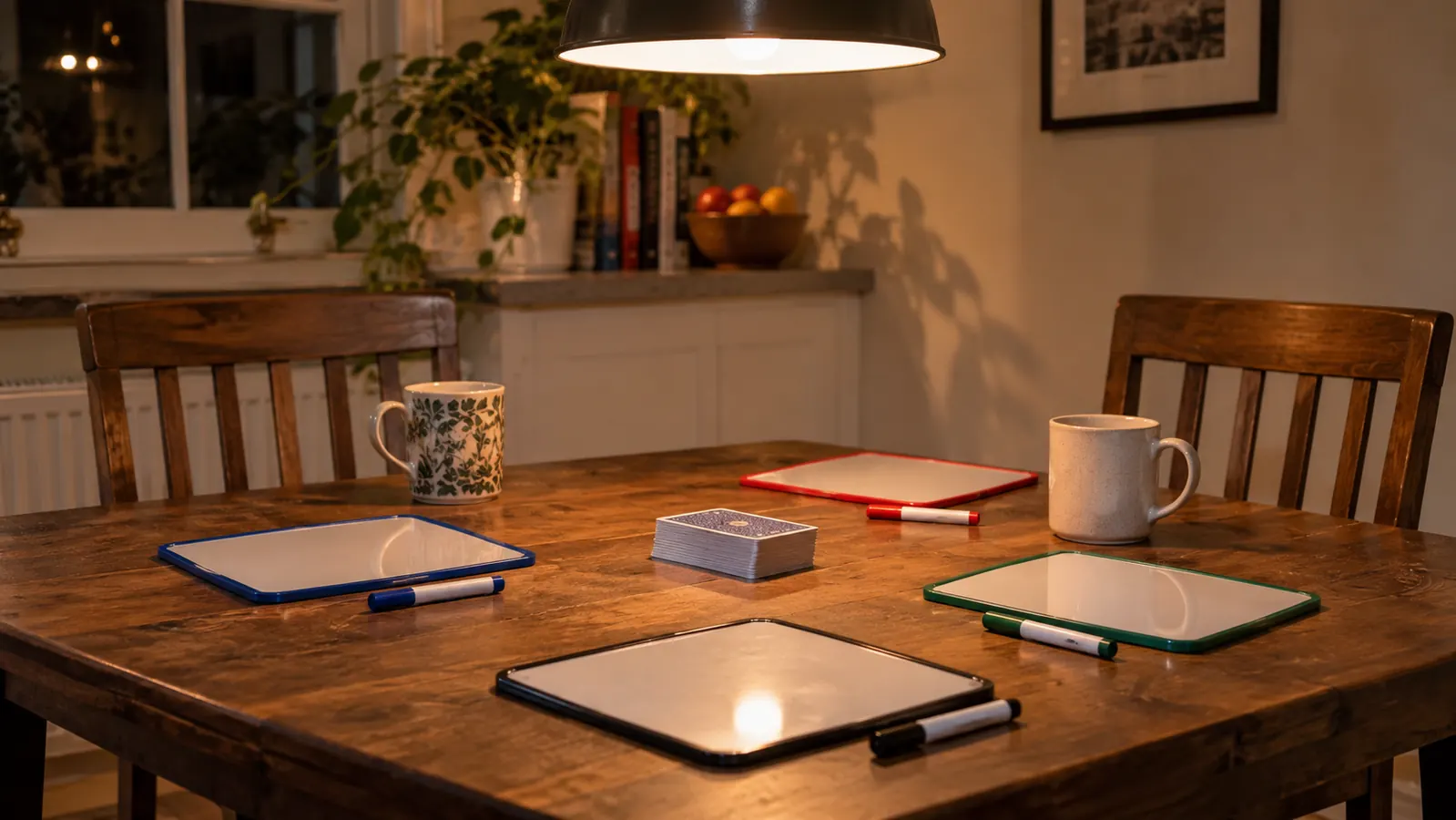
Walt and I had been married thirty-eight years when I noticed we had run out of things to say that were not on a list. Groceries. The truck. Whether the gutters needed cleaning before or after the cold snap. He would come in off the porch, settle into his chair, and we would cover the business of the household in about eleven minutes and then watch television until it was a respectable hour to go to bed. Nobody was unhappy. We were simply running on the same four topics, and we had gotten very good at them.
If you have ever driven home from a restaurant with your partner and realized the only conversation you had was about the parking and the waitress, you know the feeling I am describing. I went looking for something to put on the kitchen table that would get us talking without it feeling like a homework assignment. We landed on a card game called Answer This, made by The World Game, and the box has lived beside the salt shaker ever since. What follows is how we actually run a couples game night around it. The game turned out to be the easy part. The evening is the part that needed practice.
One deck and six little boards, and a Saturday that did not end at eight o'clock
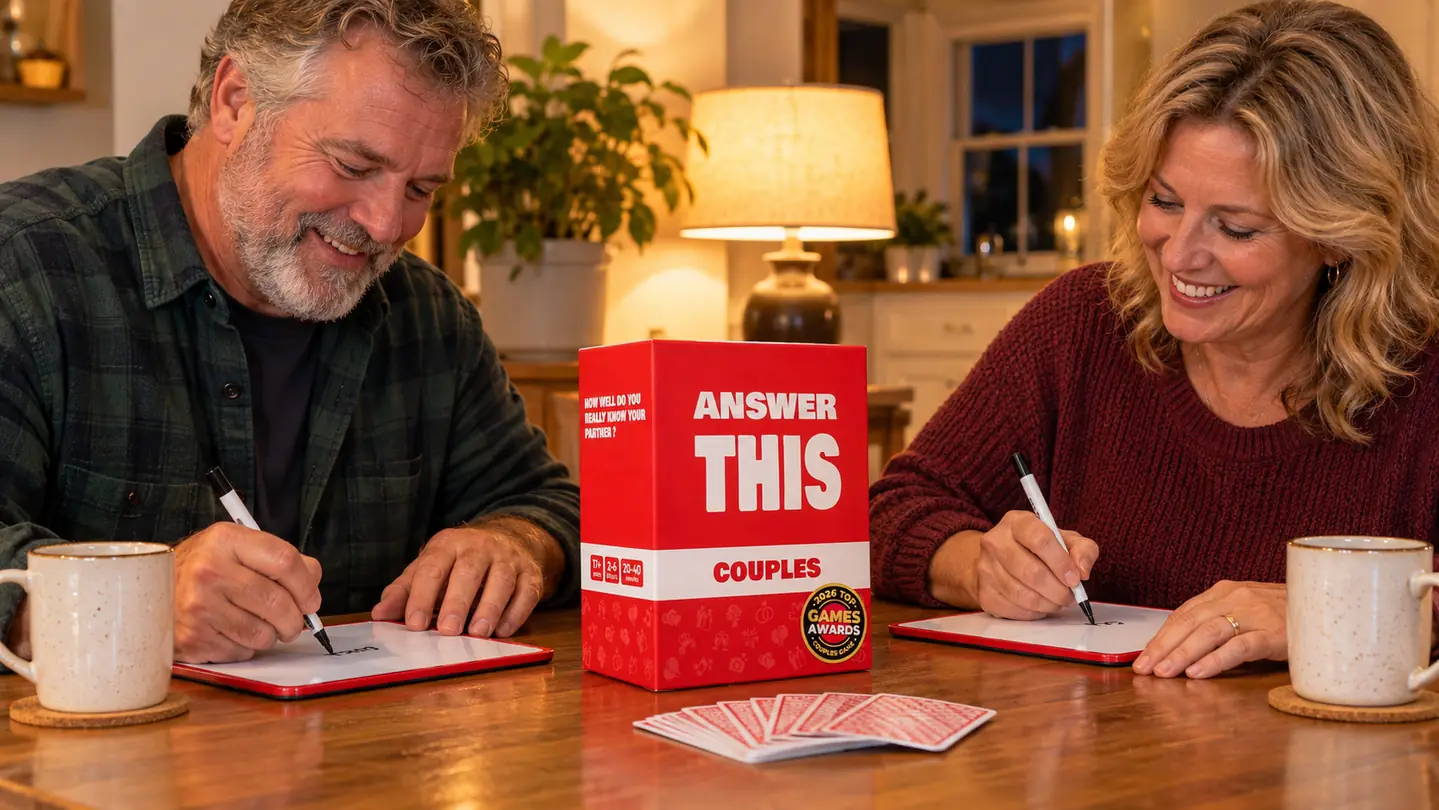
Answer This is 150 question cards, six dry-erase boards with markers, and a simple rule: the first player or team to answer ten questions correctly wins. Two to six players, one to three couples, ages seventeen and up. It is a game with a winner, not a workbook, and that is exactly why a quiet man will sit down and play it.
Amazon See Answer This on Amazon →Step 1: Pick One Night and Get the Phones Out of the Room
The first thing that kills a game night is not a bad game. It is the phone face up on the table. Walt is worse about this than I am, and I say that with love. So we made a rule that has nothing to do with the cards: whichever night we pick, the phones go face down in a bowl on the counter by the coffee maker, out of reach and not just out of sight. If one of the kids calls about a grandchild, we will hear it ring and we will answer it. Everything else can wait until morning.
Choose a night that is not already crowded. Friday sounds good until you remember you have been up since five, and the idea of being charming at eight in the evening is asking a lot of anybody. We landed on Saturday after supper, mostly because supper is over and the dishes are a problem for later. Put it on the calendar the way you would put a dentist appointment on the calendar. It sounds unromantic. It is the only reason it ever happens.
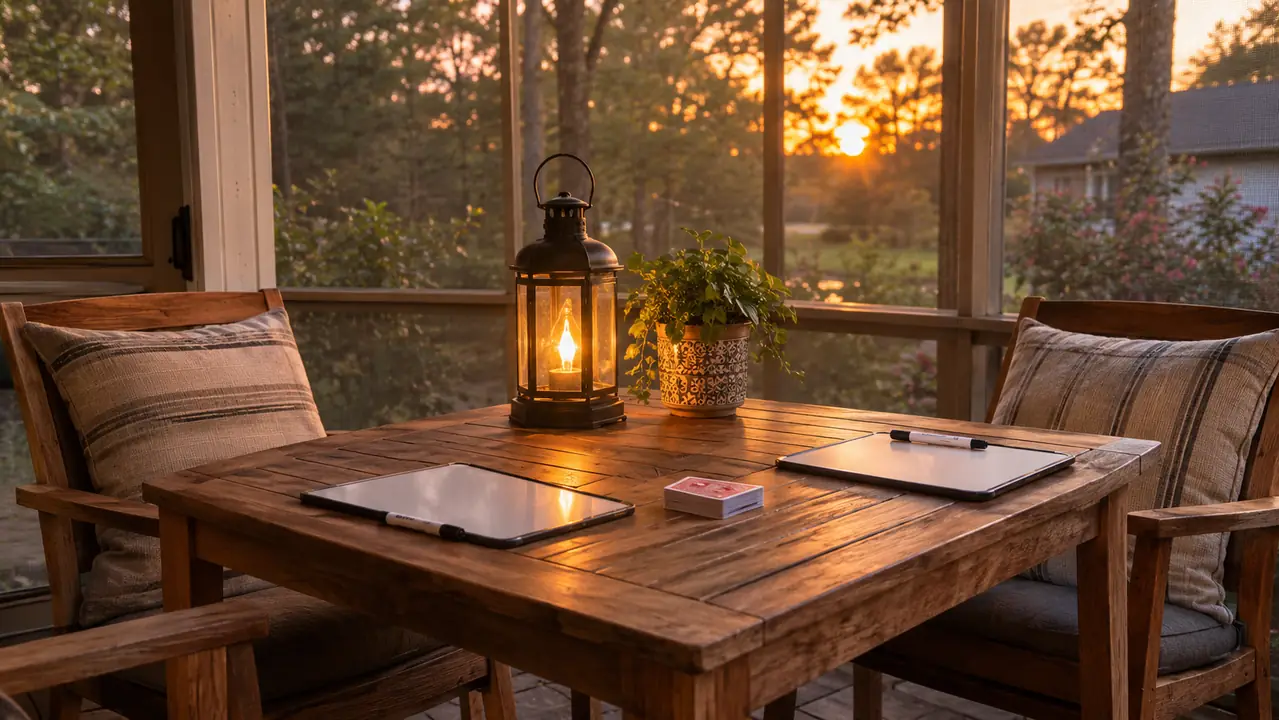
One more thing about the room. We started out on the screened porch in the fall and it was lovely right up until the mosquitoes voted otherwise. Now we play at the kitchen table from about October through April and out on the porch the rest of the year. The kitchen table works better than the living room, and I think it is because you are sitting across from each other instead of side by side on a couch, angled toward a screen.
Step 2: Set the Table Before Anybody Sits Down
Answer This comes with six dry-erase boards and six markers, which tells you most of what you need to know about how the game is played. Everybody needs a board, a marker, and room to write. So before anyone sits down, I clear off the mail, fan the boards out in the middle, and set the card box where every chair can reach it. I test each marker on a scrap of paper first. There is nothing slower than a dead marker three questions into a round.
I also put out something to drink and something small to eat, and I keep it plain on purpose. A plate of cheese and crackers, or whatever is in the pantry. The food is not the point. The point is that nobody has to get up in the middle of a question to go hunt for a glass, because the second somebody leaves the table, the table goes quiet.
Read the instructions out loud once, all the way through, even if everybody at the table swears they already know how it works. The rules are short. A card gets read, everybody writes an answer, the correct answers get counted, and the first player or team to ten takes it. Reading it aloud costs two minutes and prevents the argument at question forty, which is a real argument and always about the same card.
Step 3: Split the Couples Instead of Playing as One
This is the step I would underline if I could. The box from The World Game says it suits one, two, or three couples, and it handles two to six players. Our first night, Walt and I played against each other, just the two of us, and it was fine but a little pointed. The second time we had another couple over and we split so that each team had one person from each marriage. That was the night it got good, and we have set it up that way ever since.
Here is why. When you and your spouse are on the same team, you are performing for the other couple, and the questions turn into a little bit of a show. When you are split, you are writing down what you actually believe your partner would say, and your teammate is watching you do it. Walt wrote 'fine' on his board one night, for a question about how he would describe a perfect Sunday. I laughed so hard I had to set my marker down. He was not wrong, either.
If it is just the two of you, and plenty of nights it is, play head to head and keep it loose. The game still works with two people. What you lose in noise you gain in honesty, because there is no audience to play to. Just agree up front that neither of you is going to get wounded by a wrong guess. A wrong guess means your partner guessed wrong. It does not mean anything about your marriage.
Step 4: Keep Score Out Loud and Let It Get a Little Loud
Scorekeeping is part of this game, and that is what separates it from a deck of conversation starters sitting in a drawer. There is a winner at the end. Somebody gets to ten first, and somebody else has to hear about it. That small bit of competition is what keeps Walt at the table past nine o'clock, and I am not too proud to use it.
Keep the tally where everybody can see it. I use the back of an envelope, but a napkin works just as well. Announce the score every few rounds so nobody loses track and nobody can quietly revise history. And let the trash talk happen. Walt is the quiet one in this house, and hearing him say 'I know you better than you know yourself' across a kitchen table is worth the whole evening, even when he turns out to be wrong about what I would order in a restaurant.
One caution, and I mean it. The game is for ages seventeen and up, which means some cards will land on things you have not discussed in a while. If an answer gets close to the bone, laugh, write it down, and move on. Score it and keep dealing. The kitchen table at nine at night is not the place to open an investigation.
Step 5: Close With One Card Nobody Scores
Here is the part that is not in the instructions, and it is the part I would keep if I had to throw the rest away. When the game is over and the boards are wiped and somebody has won, we each take one card and answer it out loud, honestly, with no board and no score. Just one card. It takes about five minutes.
That last card is where the real talking tends to happen, because the pressure is off. You are not trying to win, and you are not writing anything down that the other person is going to see and grade. Walt has said more useful things in those five minutes than in the two hours before them, and so have I. It is the difference between a game and a conversation, and it is the reason we still do this on a Saturday.
If that sounds too earnest for you, skip it. You will still have had a good night, and the game will still have done its job. But if you try it once and it lands, my guess is you will not skip it again. There is something about the score being final that lets people say the thing they were not going to say while it was still on the line.
What Else Helps
A handful of things make the evening smoother that have nothing to do with the cards. The first is light. We turn the overhead off and use the lamp above the table. It sounds fussy. It changes the whole room. The second is music, kept low enough that nobody has to raise their voice over it. The third is the other couple. Invite people who actually like each other. A couples game night with one couple in a fight is a long evening for everybody, and no deck on earth can fix it.
Have a backup plan and use it early. If the game is not landing on a particular night, do not grind through forty more cards out of politeness. Wipe the boards, put the deck back in the box, and pull out something else. The cards will be there next week. The World Game put 150 question cards in this box, so you are not going to run out, and there is no rule anywhere that says a game has to be finished in one sitting.
Last thing. If you are the one who bought the game, do not spend the evening running it. Hand the card box to somebody else and let them read. Walt reads the cards now. He reads them slower than I would, and he does a better job, because he actually lets people think before he moves to the next one. Sit down. Play. It is your night too.
There is a winner at the end, and somebody has to hear about it. That small piece of competition is what keeps a quiet man at the table past nine o'clock.
If your kitchen table has gotten quiet, this is the simplest way back to a conversation
150 question cards, six dry-erase boards and markers, and a rule you can learn after supper. Two to six players, one to three couples, ages seventeen and up. Ours lives beside the salt shaker. Yours can live wherever you keep the things you actually use.
Amazon Check Today's Price on Amazon →