

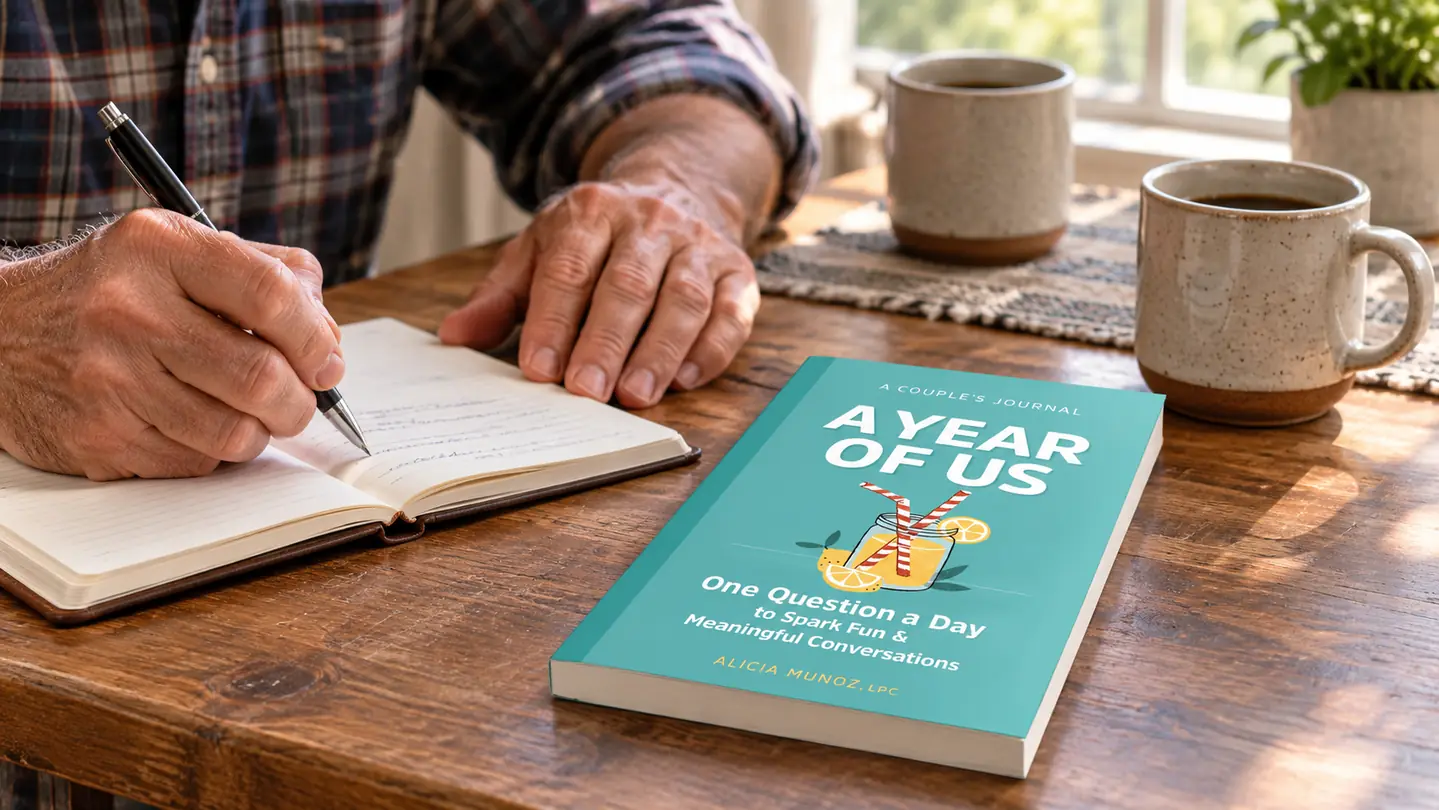
Walt and I have been married thirty-eight years, and last February I caught us talking about the weather four nights running. Not a fight. Not a cold spell. Just the same three subjects on rotation: the errands, the grandkids, and whether it was going to rain on the porch furniture. He is a quiet man by nature. I am not. But somewhere between his retirement and mine we had both gotten out of practice at saying anything that had any weight to it. So I went looking for something to put on the kitchen table that would make the talking easier, and what I landed on was a book called A Year of Us. It asks one question a day. I want to tell you how we actually started using it, because the starting was the hard part.
Buying a shared journal and starting one are two different skills, and nobody explains the second. I have watched two friends buy a nice book, write in it twice, and park it in a drawer next to the good scissors. The book was never the problem. The problem was that they treated it like a project instead of a habit, and habits need a place to live. What follows is the version that worked at our house, in order, including the parts where Walt rolled his eyes. If you take nothing else from this, take the first step, because it is the one that decides whether you are still doing this in March.
One book, one question a day, two pens. That is the whole setup.
It is not a program and it will not run itself, but it makes the first sentence of a real conversation a lot easier to find. Today's price is on the listing, and the first question is already waiting for you.
Amazon Check today's price on Amazon →How We Do It, Step by Step
Step 1: Use a Time You Already Share
Do not schedule a relationship meeting. That is the fastest way to make a book feel like a dentist appointment. Instead, find a slot that already exists in your day and slide the journal into it. Ours is coffee, before Walt goes out to the garage and before I start on whatever I have decided needs doing that morning. Twenty minutes, most days. We are both awake, neither of us is hungry, and nobody is tired enough to give a one-word answer just to end it.
The point is that you are not adding an event to the calendar. You are putting something into a moment that was already going to happen. If your shared moment is supper, do it at supper. If it is the porch after the dishes, do it there. What you are looking for is the ten minutes a day when the two of you are in the same room and not actively doing something else. In our house that rules out Sunday afternoons, because Walt is either watching a game or asleep in front of one.
One warning. If you pick a time that only works on weekends, you will do it on weekends and nowhere else, and two days out of seven is not enough to build a habit. We tried Saturday mornings for a while. It turned into a once-a-week catch-up that felt like a staff meeting. Daily-ish is the goal, even if daily-ish means four mornings out of seven.
Step 2: Keep It Where You Sit, Not Where You Sleep
Our copy of A Year of Us lives on the kitchen table, on the corner nearest the window, closed with a pen clipped into it. It does not live on the nightstand. I tried that with a different book years ago and it became bedtime reading, which is code for reading half a page and falling asleep. The kitchen table is where we already talk, so the book sits where the talking already happens and reminds us without either of us having to bring it up.
There is a second reason for the table. A book on the kitchen table gets seen by both people. A book on one person's nightstand becomes that person's project, and the other one starts to feel like they are being assigned homework. If you have a spot where you both land at the end of the day, that is your spot, whether it is a kitchen counter, a porch side table, or the arm of a couch. Put it there and leave it open to the current day if you can stand to. An open book is a lot harder to walk past than a closed one.
One caution about placement. Do not put it anywhere it will get knocked into the sink or dusted with flour. We learned that the hard way with a recipe notebook and a batch of biscuits, and I am still finding dried dough in the spine of that thing.
Step 3: Answer First, Then Hand It Over
Here is the part that made the difference for us. Whoever picks up the book answers the question out loud before the other person ever sees it. Not write it down first and pass the book over. Answer it with your mouth, in the room, where you have to watch the other person's face while you do it. That is a different thing than writing an answer and sliding a book across the table, and it is the thing that gets a quiet man talking.
Walt's default answer to almost anything is 'fine.' It is not rudeness, it is economy. He spent thirty-odd years climbing into attics and crawl spaces and he learned to give the short answer and get back to work. So when a question about, say, what he remembers from the first apartment we rented comes up, and I answer first, he hears me fumble through it and he has something to push against. It is easier to add to a story than to start one from nothing. Give him something to add to.
It is easier to add to a story than to start one from nothing. Give him something to add to.
One more thing about this step: answer honestly, not impressively. If the question is about a hard year, say something true about the hard year. The book is not a performance and the other person can tell. The first time I gave a polished answer instead of a real one, Walt gave me a polite answer back and we both knew we had wasted a page. We got better at it.
Step 4: Two Pens, No Correcting
We use two pens, and they are different pens, because I want to be able to tell at a glance who wrote what. That is the only rule we have about the writing itself. Nobody corrects spelling. Nobody comments on handwriting. Nobody reads ahead to tomorrow's question and starts planning an answer, because that turns a conversation into a test.
The no-correcting rule matters more than it sounds. When you have been married a long time you develop a very fast editorial reflex about your spouse's version of events. The vacation where the car broke down. The year we moved. Your memory has a slightly different shape than theirs and the urge to correct the shape is strong. Resist it in the book. The book is not the record. It is the conversation. If his memory of the flooded basement is funnier than mine, let the funny one stand and argue about it at supper.
We also do not read each other's older entries without asking. That is not a privacy rule so much as a manners rule. If Walt wants to look back at what he wrote in March, that is his business until he chooses to show me. A journal you share is still made of two people's separate thoughts, and treating it that way keeps both people willing to write something true.
Step 5: When a Question Lands, Follow It
Some questions get a shrug and a two-sentence answer, and that is fine. Others open something up. When that happens, close the book. Put the pen down and follow the conversation wherever it goes, even if it means you skip three days of entries or never come back to that page. The book's job was to start the conversation. Once it has started, the book is in the way.
This is the step people skip, and it is the one that turns a nice habit into something that actually changes a marriage. A journal is a doorway, not a room. If you treat every question as a task to be completed and closed, you will finish the book in a year and have exactly the same conversations you were having before. If you treat the good ones as doors, you end up somewhere you did not plan to go. That happened to us on a question about what we would do with a completely free Saturday. We ended up talking for an hour and a half about a trip we have never taken.
When It Stalls, and It Will
You will miss days. We missed most of October, twice, once for a grandchild's birthday and once because we were both worn out and it was easier to watch television. Missing days is not failure, it is a Tuesday. The only thing that matters is that you pick it back up without a speech about how you have been neglecting it. A shared journal that comes with guilt attached is a journal that goes in the drawer next to the good scissors.
The other stall is the one where one of you loses interest and the other keeps going. That is worth talking about plainly, without turning it into a referendum on the marriage. Sometimes the answer is that the two of you need a different time of day. Sometimes it is that the questions have gotten a little too soft or a little too pointed and you need to say so. And sometimes the answer is that a book is not what that person needs this month, which is allowed. We have had months where Walt wrote two words and I wrote a paragraph, and months where it flipped.

What Else Helps
A book is one tool, and it is not the only one. What worked alongside it for us was three things. First, we started taking a walk after supper, which is where a lot of the follow-up conversations actually happened, away from the table and the television. Second, we got in the habit of asking one real question at supper that had nothing to do with logistics, which sounds small and is not. Third, and this is the unglamorous one, we stopped assuming the other person already knew something just because we had been married thirty-eight years. Long marriages run on shorthand, and shorthand leaves things out. If you want a second option for the same job, a shared book is easier to keep up with than a deck of cards, and I have tried both. The card decks are fun at a party. A Year of Us is the one that stayed on our table.
The other thing that helped was lowering the bar on what counted. Some days the answer is three words and the conversation is ninety seconds, and that is a perfectly good day. The book does not care whether you were profound. It only cares that you showed up and said something out loud. Consistency did more for us than depth ever did, and I say that as a person who likes a deep conversation.
If you are going to start, start tonight, not in January
Pick a time you already share, put the book where you sit, and answer the first question out loud before you hand it over. That is the whole method. It has worked at our kitchen table for a year, and it is the only thing I have found that gets Walt talking without me having to pry.
Amazon See the journal on Amazon →