
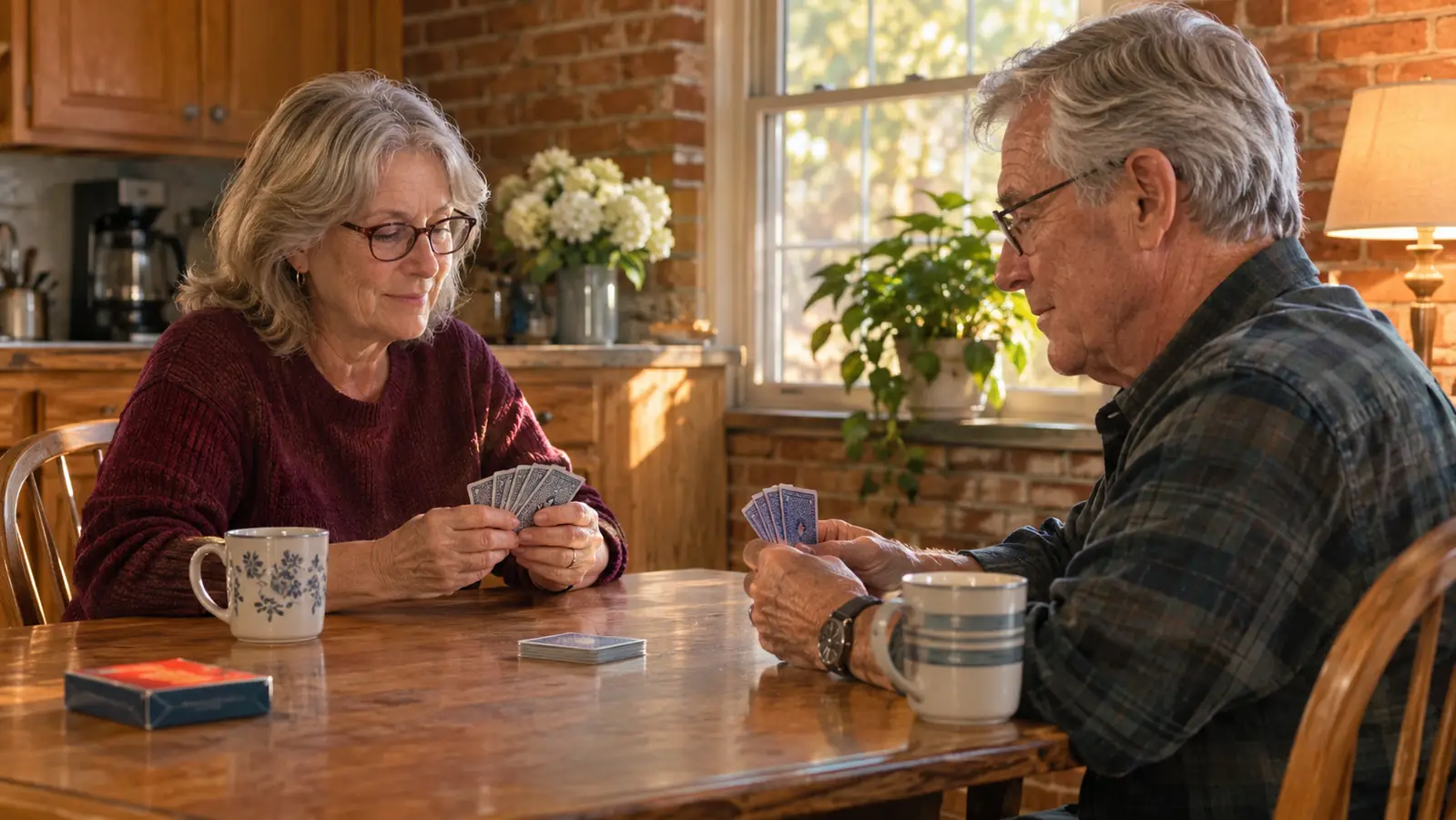
I am going to tell you the honest thing first, because the product page will not. Renegade Game Studios makes a two-player card game called Fox in the Forest Duet, and my husband Walt and I have played it somewhere north of sixty times since last spring. It did not save our marriage. Our marriage did not need saving. What it did was give us thirty minutes at the kitchen table where neither of us could reach for a phone or slide into a conversation about the gutters. That is a smaller promise than the internet usually makes about couples games, and it is the only one I can honestly stand behind from this chair.
Walt is sixty-four, retired from HVAC work, and the kind of man who answers a direct question with 'fine' and considers that a complete report. I am Delphine, sixty-two, and I spent most of my working life in a school office, which means I got very good at filling silence so nobody else had to. Thirty-eight years in, that combination is not a crisis. It is a rut, and ruts are quiet, and quiet is easy to mistake for settled until you notice you have talked about errands for four straight days.
So last spring I went looking for something to put on the table between us that was not a screen. What follows is what I found, what I wish someone had told me before I opened the box, and who I think should walk right past it and spend their money elsewhere.
The Quick Verdict
A genuinely cooperative two-player card game, not a conversation deck. We have played it more than sixty times and the thirty minutes are the whole point. Clumsy first night, then it clicks.
Amazon Check Today's Price →Thirty minutes, two people, no screens
Cooperative trick-taking means you cannot win by yourself, so the table talk comes out of the rules instead of out of a prompt card.
Amazon Check Today's Price on Amazon →What Nobody Tells You Before You Open the Box
The first thing nobody tells you is that cooperative does not mean easy. This is a trick-taking game, which means you and your partner are each playing one card at a time into the middle of the table and the higher card wins the round. In most card games of that shape you are trying to win those rounds. Here, winning the right rounds is how you gather the gems you both need, and winning the wrong ones costs you ground. Same mechanics you already know. Completely different reason to care about them.
The second thing is that the goal belongs to both of you. There is no scoreboard with a winner on it. When the game goes wrong it goes wrong for the pair of you at the same time and in the same direction, and there is no way for either person to quietly decide it was the other one doing. That sounds like a small design choice. It is the whole reason the thing works at my table.
The third thing is that it is a quiet game. No timer, no buzzer, no countdown that makes people shout. The box says thirty minutes and that has been close to true for us, and most of those thirty minutes are two people looking at their cards and thinking. If what you want is a game that gets you laughing loud enough to wake the house, this is not that. If what you want is a game that gets you talking, this will do it, but the talking is the low and deliberate kind.
The fourth thing, and this one matters if there is ever a third person in the room, is that it is for two players and only two. Renegade Game Studios designed it for exactly that number. Nothing was bolted on to make room for a third chair, and you can feel that when you sit down to play it.
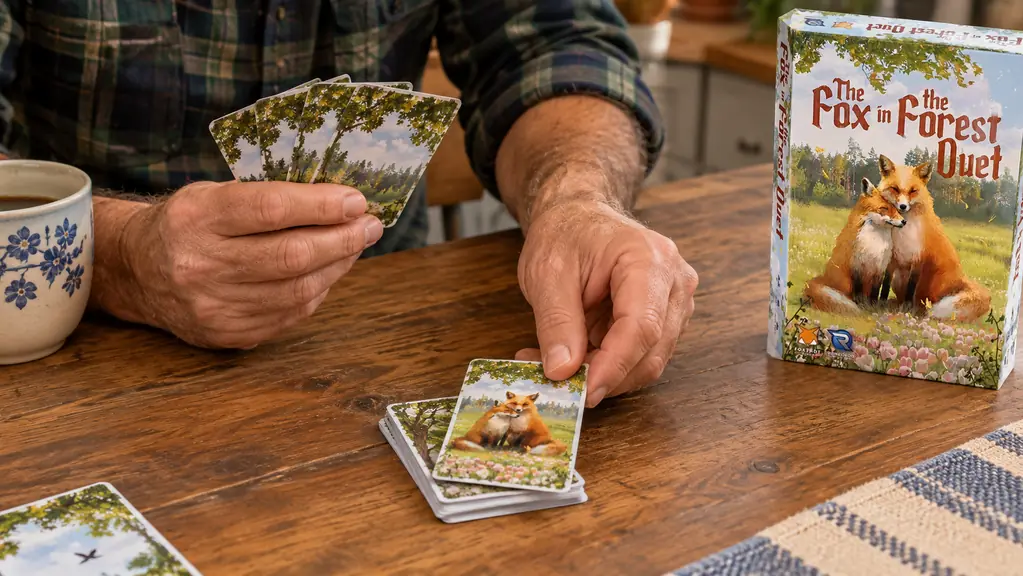
How Two Quiet People Actually Played It
Our first night was not good. I read the rules out loud, which is a habit of mine, and Walt nodded at intervals in a way that told me nothing. We got something wrong for the first several rounds and did not work it out until the end came out strange. Then the box sat on the counter for four days.
The second night we played it properly, and it clicked somewhere around the halfway point. Walt, who narrates nothing about anything, started saying things like 'I need you to take this one' and 'I cannot help you here.' Short sentences, no speeches. But they were sentences about what he wanted, which is not something I get much of in a normal week. I noticed. I did not make a fuss about it, because making a fuss about it is a reliable way to get a quiet man to stop talking.
By the sixth or seventh play we had a shorthand going. That is the part I did not expect. A cooperative game between two people who have been married long enough to finish each other's sentences turns out to have a second layer underneath it, because you start noticing how your partner thinks when the stakes are nothing at all. I have learned more about how Walt approaches a problem from this box than from a decade of asking him how he approaches problems.
There was one night in February I still think about. We had both had a long week and neither of us wanted to talk, so we played instead, and about twenty minutes in Walt said something about his retirement and how strange the quiet had been at first, which is a thing he had not said out loud in the four years since he stopped working. The game did not ask him to. His hands were busy, there was no pressure to fill the silence, and it came out sideways. That is the most honest thing I can tell you about what this box does.
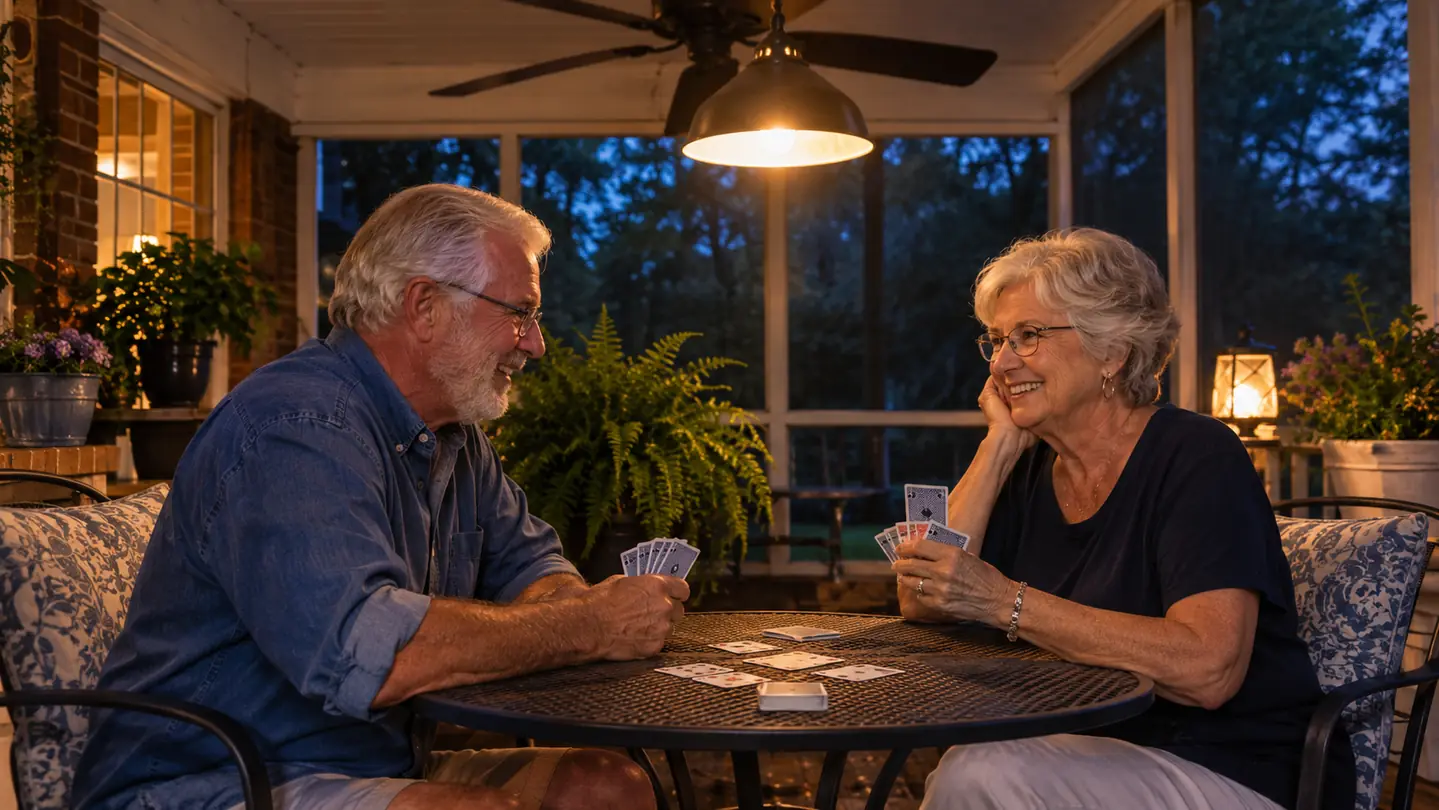
It also gave us something to do on a Tuesday. That sounds like a small thing. It is not a small thing. The screened porch is unbearable in an Alabama July and the kitchen table takes over in winter, and either way, half an hour with a deck between us is half an hour we are not sitting in separate rooms watching separate screens.
The Part That Surprised Me
What surprised me is how a loss lands. When we come up short, we come up short together, and neither of us can be blamed for it. After thirty-eight years of being able to locate fault with real precision, that is a strange experience. The first time we ended a game with gems still uncollected, Walt laughed. Not a big laugh, a short one. Then he said, 'Well, that was our fault.' Our. I have been turning that word over for months now.
The character powers are what keep it from going stale. Different powers change how each of you is able to help, so the same two people with the same deck end up carrying different obligations from one night to the next. We have had rounds where I was the one who could pull us out of a bad spot, and rounds where all I could do was watch and hope and play the card I had.
And it is short. Thirty minutes means we can play it on a weeknight without either of us deciding it is too late to start something. A game that takes three hours gets played on holidays. A game that takes half an hour gets played on a Tuesday, and the Tuesdays are where a marriage actually lives.
We came up short together, and neither of us could be blamed for it. After thirty-eight years of locating fault with real precision, that turns out to be a relief.
Where It Stumbles
The rules took us two reads and one false start, and I do not think we are slow. The book assumes you already know how trick-taking works, and if you have not played cards since a family reunion in the nineties you will be reading with a finger on the page. That is not a flaw in the game itself so much as a flaw in how it is taught, and it cost us one bad evening. Plan for that evening. It ends.
There is luck in it. You draw cards, and a bad draw can sink a round you played well. Cooperative games soften that, because you are not losing to a person, but it still stings to lose to the deck rather than to a decision. If you need your losses to feel earned, this will occasionally irritate you.
It is also not a conversation deck, and I want to be plain about that, because the shelf next to this one is full of products that are. Nobody hands you a card that says 'tell me about your father.' This is a card game. The talking it produces is the ordinary kind that happens when two people are working on the same problem with their sleeves rolled up. It is a side effect rather than a feature, and it is the entire reason I keep it in the house.
And it is two players. If your version of a good evening involves four people and a bowl of pretzels, this is the wrong box. There is no version of this that expands gracefully, and I would not try.
The Small Box and the Long Haul
The whole thing weighs almost nothing and lives in a box small enough to go in a tote bag. Ours has been to our daughter's house for Thanksgiving and got played on her coffee table after the dishes were done, which is about the highest compliment a game can get from me. The cards are paper, we are not hard on things, and after more than sixty plays ours still shuffle and still look like themselves.
Whether it holds up over years I cannot tell you yet, because we are only a year in. What I can tell you is that nothing about it feels like it is running out. The powers vary, the deck varies, and the two of us vary depending on what kind of day we have had. That is enough variation for a kitchen table.
What We Compared It To
Compared to the plain deck of cards already in the drawer, Duet earns its place because of the character powers and the shared target. You cannot get to the same conversation with a game of rummy, because rummy is you against him and the entire point is to win. That is the difference I was after, and it held up. Renegade Game Studios made a game that only works with two people, and from where I sit that is a compliment rather than a limitation.
We also own a shelf of two-player games, and the honest comparison is this: the competitive ones come out when we are in the mood for a little friction, and this one comes out when we are not. Some nights I want to beat him at something. Most nights I want to sit across from him and work the same puzzle from opposite sides of the table. If you already have a game you both love, you may not need this one at all, and I would rather tell you that than sell you something.
What I Liked
- Truly cooperative: you cannot win by yourself, so the talking is built into the rules
- Designed for exactly two players rather than adapted for two
- Thirty-minute games that fit a weeknight
- Character powers keep the same deck feeling different from one night to the next
- Small and light enough to travel and forget you packed it
Where It Falls Short
- The rules take two reads and one rough first evening
- A bad draw can decide a round you played well
- A thinking game, not a loud one
- It is a card game, not a guided conversation deck
- Two players only, with no graceful way to add a third
Who This Is For
If you and your partner already play games, this is an easy yes and you can stop reading. If neither of you has touched a trick-taking game since you were a child, it is still a yes, with the understanding that your first night will be clumsy and that the clumsiness is not a sign you bought the wrong thing. Give it a second evening before you decide anything.
It is also for the couple in the rut, the ones whose conversation has narrowed to errands and weather and the grandchildren. Not because a card game repairs anything. Because half an hour spent solving one small problem together is a different kind of half hour than the ones you have been having, and different is where these things start.
And it suits people who like a puzzle more than a performance. There is nothing to perform here. You are not telling a story or answering a question. You are looking at cards and trying to work out what your partner needs, which is a skill that transfers to other rooms in the house.
Who Should Skip It
Skip it if you need a game for a group, because this is two people and only two people. Skip it if competition is the fun for you, because there is no beating each other and some couples genuinely enjoy the spark of a rivalry. Skip it if what you are shopping for is a guided conversation, because this does not do that, and pretending otherwise would set you up to be disappointed at your own kitchen table.
Skip it, too, if either of you goes sour when luck turns. Cooperative games are lovely until somebody at the table decides a loss was the other person's fault, and at that point they are harder than competitive games, because there is nowhere for that feeling to go. We have not had that problem. I know couples who would.
The best half hour we bought last spring
A small box, two players, thirty minutes, and one shared problem instead of two separate screens. That is the whole offer, and it has held up for us.
Amazon Check Today's Price on Amazon →