
Walt and I have been married thirty-eight years, and somewhere in the middle of that we stopped talking about anything that was not a grocery list. He retired from HVAC work. I retired from the school office here in Huntsville. Suddenly we were in the same brick ranch house all day with the weather, the errands, and the grandkids on the phone every other Sunday. That is how I ended up buying two-player card games. A game gives you something to do with your hands while a real conversation sneaks up on you. I did not know that when I started. I know it now, and I have the drawer full of things that did not work to prove it.
Fox in the Forest Duet by Renegade Game Studios was the fourth game I brought home and the only one that lasted. It is a cooperative card game for exactly two players, thirty minutes from shuffle to finish, and it takes up about as much table as two dinner plates set side by side. We have played it most weeknights since February. That is longer than anything has held Walt's attention in years, with the possible exception of the weather radar and the price of diesel. Renegade Game Studios built something small here, and small is the reason it gets played.
The Quick Verdict
A cooperative two-player card game that got two quiet people talking about something other than the to-do list. It is not a conversation deck, and it will not fix a marriage, but it does the job people buy a conversation deck hoping it will do.
Amazon Check Today's Price →Two players, one shared pile of gems, thirty minutes
If your evenings have thinned out to errands and weather, this is a small way to put something else on the table.
Amazon Check Today's Price on Amazon →How I've Used It
Our routine is not romantic. Dishes done, table wiped, Walt pours whatever coffee is left in the pot, and I deal. Two rounds on a weeknight, three on a Friday. The game says thirty minutes and that is honest, though our first night took closer to fifty because we kept rereading the rules and arguing about whether we had already lost. We had.
We played it on the screened back porch in October until the mosquitoes ran us inside, then at the kitchen table all winter. It has been to our daughter's house at Thanksgiving, where it rode in my purse beside the tissues. It went to a waiting room in January when Walt had a procedure and we needed something to do besides stare at the wall and read the same poster twice. Nobody there knew we were playing a game about collecting gems. It looked like two old people sorting cards, which it also was.
The box weighs 0.17 kg, which is nothing, and it fits in a coat pocket or the glove box of a truck. That matters more than I expected. The first game I bought for us was the size of a briefcase and it has not left the closet since 2023. This one goes where we go, so it gets played instead of admired.
What I did not expect is that it became the part of the evening we both look forward to. Walt is the quiet one. He answers most questions with 'fine' and he has since I met him. But he does not answer a card game with 'fine.' He answers it by pointing at a card and telling me what he needs from me, and that is more conversation than I got out of him across a whole dinner. The first night we played, he lost a round for us by playing the wrong card, looked over at me, and said, 'Well, that was my fault.' I have been trying to get him to say that about the gutters for two years.
What Comes in the Box and How a Round Runs
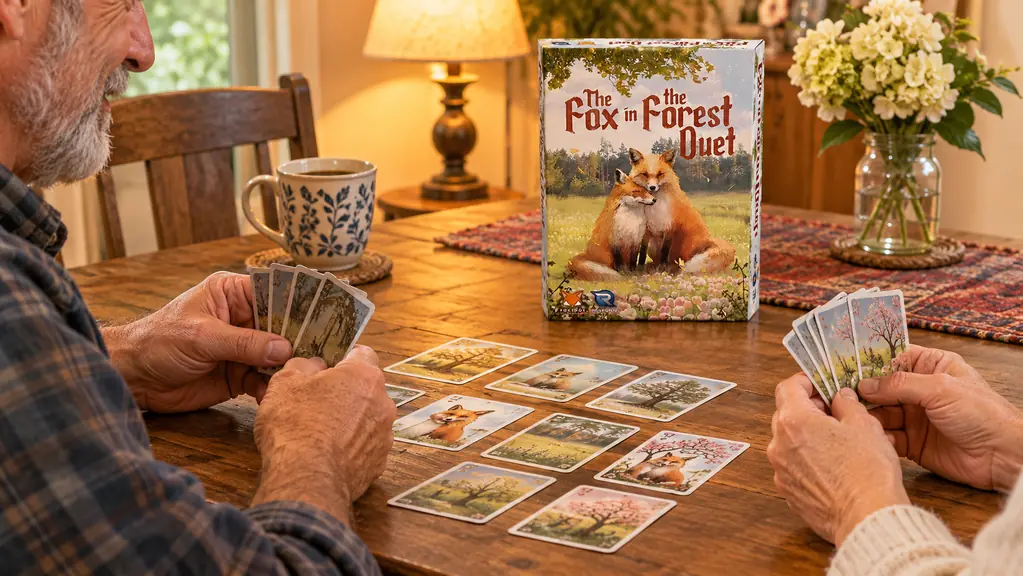
The box is small and the cards are paper, which worried me, because Walt shuffles hard enough to bend a deck. Inside you get the cards and the gems you are trying to collect together. The whole thing weighs 0.17 kg and is put out by Renegade Game Studios with English rules in standard packaging. The listing says ages ten and up, and that felt about right to me. Our grandson could follow it with some help. Our granddaughter would beat us both and then explain what we did wrong.
Setup takes about two minutes, which matters to me more than it used to. There is no board to unfold, no pieces to punch out of a sheet, nothing to sort into little baggies. You shuffle, you deal, you go. Walt can have a round dealt before the coffee finishes dripping, and he has done exactly that more than once.
It is a cooperative trick-taking game, a phrase I had explained to me twice. In the trick-taking games my mother played, you win tricks to beat the person across the table. Here the person across the table is your partner. You win tricks to collect gems, and you have to collect them before the cards run out. Win the right tricks and you both win. Run out of cards first and you both lose. There is no arrangement where Walt wins and I lose. After thirty-eight years and a lifetime of card games where somebody had to lose, that took some getting used to.
Each player also has a character with a special ability, and those abilities let you bend the ordinary rules in small ways. That is the part that keeps it from going stale. By the fifth or sixth play you are not only playing your own hand. You are watching what your partner does not play, making guesses about what he is holding, and trying to leave him room to do what he needs to do. The fairy tale theme is on the cards and in the character names, and it is pleasant without being cloying, which is more than I can say for the deck with the kittens on it that we tried in the spring.
The Rules Do Something a Conversation Deck Cannot
I own two conversation decks. I bought them in the same stretch, when I first noticed that Walt and I could go a whole day on the subject of the gutters. They are fine. They live in the drawer with the batteries and the spare key. The trouble with a deck of questions is that it announces itself. Somebody has to say out loud, 'let's do the question cards,' and then you are both sitting there performing openness, and Walt's answer is 'fine,' and the deck goes back in the drawer.
A game does not announce itself that way. You are not sitting down to talk about your feelings. You are sitting down to beat a deck of cards, and while you are busy doing that, you are also paying attention to another person, noticing what they need, and saying short true sentences like 'I need you to take this one.' That is the whole trick. The talking is a side effect of the game rather than the assignment.
Twice now we have finished a round and kept sitting there, talking about something that had nothing to do with cards. Once it was about whether Walt is actually happy being retired, which is not a question I had managed to get an answer to across a dinner table in three years. I am not going to claim a card game caused that conversation. I will claim it did not hurt, and I will claim the game is the reason we were still at the table when it happened.
There is a reason this works, I think, and it is not mystical. Two people doing a shared task side by side will talk more freely than two people facing each other with nothing to look at but each other. Every long car trip Walt and I have ever taken proves it. This is a thirty-minute version of a long car trip, and it does not require a destination or a tank of gas.
Walt does not answer a card game with 'fine.' He answers it by pointing at a card and telling me what he needs from me, and that is more conversation than I got out of him across a whole dinner.
What Renegade Game Studios Got Right
I had never heard of Renegade Game Studios before I bought this. I bought it because the box said two players and thirty minutes and I liked the picture of the fox. What I have come to appreciate since is the restraint. Renegade Game Studios did not stuff the box with a score pad, a board, or a sheet of cardboard tokens to punch out and lose under the couch. There are cards, there are gems, there is a rulebook, and that is the game.
The other thing Renegade Game Studios got right is the length. Thirty minutes is exactly long enough to feel like an evening's activity and short enough that a tired man will agree to it on a Tuesday. I have bought games that promised ninety minutes of togetherness and delivered forty minutes of one of us checking the clock. This one ends while we still like each other, which is a design decision somebody made on purpose.
And there is nothing to charge, nothing to update, and nothing to subscribe to. That sounds like a small thing until you count how many things in this house need a cord and a password. The game comes out of the box, gets played, goes back in the box. In a season of screens, a paper game that fits in a purse has been a quiet relief.
Where It Falters
It is a card game, so luck is half of it. There are nights the deck hands you a mess and you lose in fifteen minutes through no fault of your own, and Walt takes that harder than he will admit. If one of you replays a loss for an hour afterward, this game will hand you material. It is not going to soften a bad night. The game does not have a difficulty dial either. If one of you is sharp and the other is tired, you play the same deck.
It is also not a conversation deck, and I want to be plain about that, because the internet is not. Nobody hands you a card that says 'tell me about your father.' You play cards about gems. If your marriage is in real trouble, this is a game, not a tool, and the two of you should be talking to somebody qualified instead of reading a review by a retired school office manager in Alabama. What the game does is lower the temperature enough that a small conversation can start. It cannot make the conversation happen, and it does not pretend to.
One more complaint, and it is small. The rules took us three readings to get right. On our first night we played a rule wrong, lost a game we should have won, and did not find out until I went back through the rulebook the next morning. It is not a complicated game once it clicks. Getting it to click cost us longer than the thirty minutes on the box.
What Weeks of Play Did to the Cards
We have played it enough that the cards have gone soft at the corners. They are paper, and they pick up a bend if you shuffle them like a man who has been dealing cards since 1979, which Walt does. Nothing has torn. Nothing has come apart. The box has a dent in one corner from riding in a bag, and the gems still go back in the same way every time, which I appreciate more than I should.
One thing I did not expect from a cooperative game: it is easier to be a good sport when you lose together. With competitive games, a loss meant one of us was the loser and the other one had to be gracious about it, and neither of us is as good at that as we would like to believe. Here a loss is just a loss. We both made the mistake. We laugh, we reshuffle, we go again.
At the current price, I have gotten more evenings out of this than anything else I have bought for the house in years, and I say that as a woman who once bought a bread machine with real conviction. The game is still on the table by the coffee maker. The bread machine is in the garage under a tarp. That is the whole review, really, and everything above it is just detail.
What I Liked
- Built for exactly two players, so nobody sits out
- Cooperative, so a loss is shared and nobody has to be the loser
- Thirty minutes of actual play, easy to fit into a weeknight
- Small and light at 0.17 kg, travels in a purse or a glove box
- Character abilities keep it interesting well past the fifth play
- It stays on the table instead of going back in the drawer
Where It Falls Short
- The rules take a few readings before they click
- Luck matters, and some nights the deck dooms you early
- No difficulty dial if one of you wants an easier game
- Paper cards will bend if you shuffle them hard
- It is a game, not a conversation deck, and it does not pretend otherwise
Who This Is For
Couples who already like card games and want one they can play together instead of against each other. Couples where one of you is quieter than the other and the talk has thinned out to logistics. Couples who need something to do in a waiting room, on a porch, or at the kitchen table after the dishes are done. Parents with a child ten or older who can handle a trick-taking game. Anybody who wants a thirty-minute activity that does not involve a screen or a subscription. And anybody who has already tried a conversation deck and watched it go back in the drawer.
Who Should Skip It
Skip it if what you want is a deck with prompts printed on the cards, because this is not that and it will not turn into that. Skip it if you want a competitive two-player game where somebody wins at the end, because the cooperation is the entire point and a competitive player will find it flat within an hour. Skip it if you need a game that seats three or four, since this one is built for exactly two. And skip it if you are hoping a card game will carry a relationship that needs more than a card game. It will not. Nothing in a box will, and I would rather tell you that than sell you something.
The one that stayed on the table
Two players, thirty minutes, one shared goal from Renegade Game Studios. If your evenings have thinned out to errands and weather, this is a low-stakes way to put something else on the table.
Amazon Check Today's Price on Amazon →