
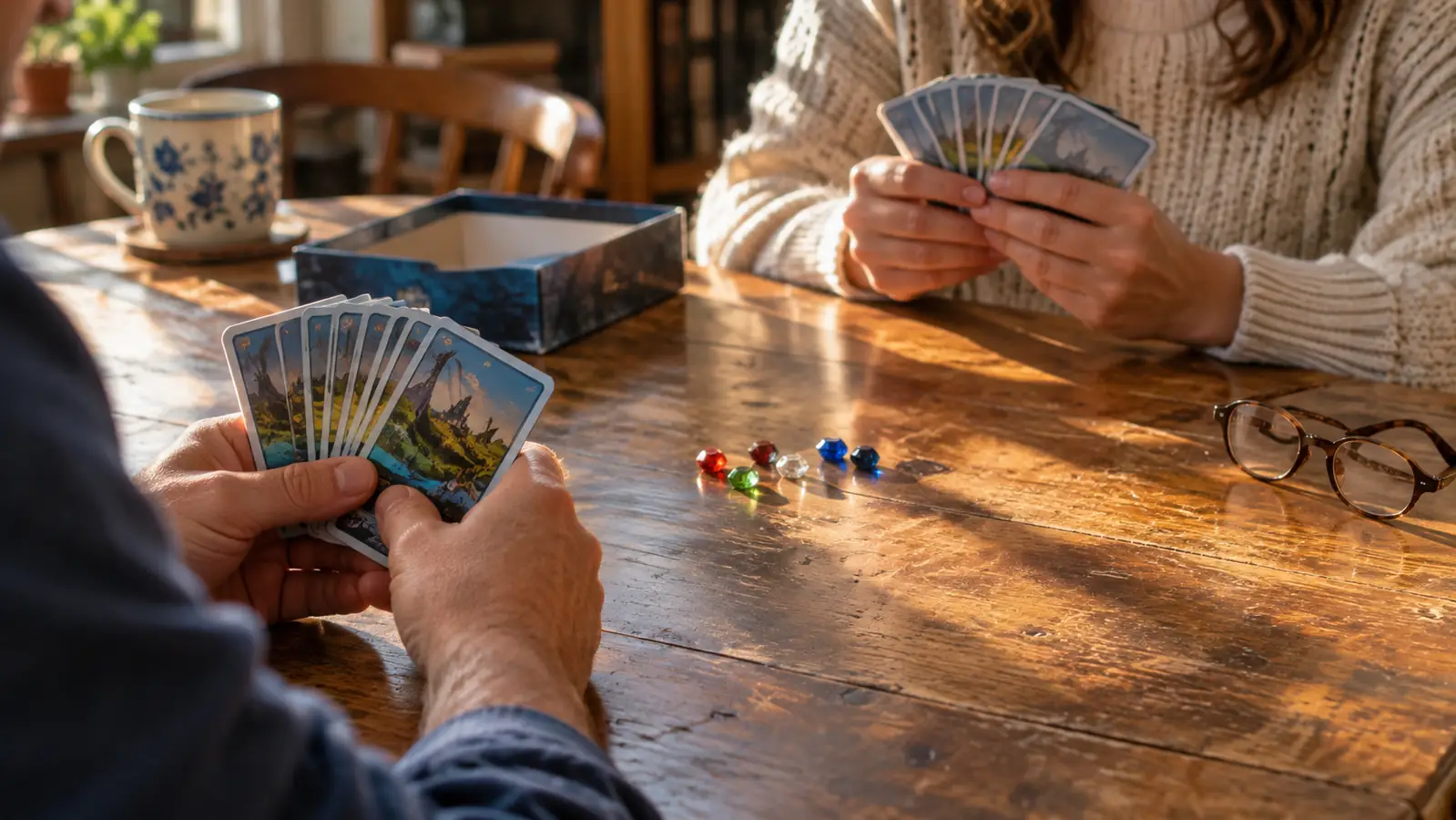
Walt and I have been married thirty-eight years, and after he retired from HVAC work our evenings got quiet in a way I did not care for. Supper, the news, a little television, bed. Most nights we covered errands, the weather and the grandchildren, and then we ran out of things to say. So I started bringing home small card games, one at a time, mostly so there would be something on the kitchen table besides the salt and pepper. Fox in the Forest Duet, from Renegade Game Studios, is one of the few that stayed.
Here is the short answer before the long one. Fox in the Forest Duet is a cooperative card game built for exactly two players, about thirty minutes a round, and its whole design pushes the two of you to solve one problem together. The two-player card games most couples already own, Lost Cities being the one I will hold up against it, are contests. One of you wins and one of you does not. Neither box is better than the other. They do different jobs at the table, and which one fits your evening depends on what you want the evening to do.
| Fox in the Forest Duet | Lost Cities | |
|---|---|---|
| Core mode | Cooperative. You win or lose as a pair. | Competitive. One of you wins, one of you does not. |
| Learning curve | Trick-taking plus a cooperative wrinkle to teach. | Play a card or discard it. Two rules and you are moving. |
| Replayability | Moderate. Character powers change what each round asks. | Deep. The expedition math keeps rewarding repeat plays. |
| Table talk | Constant. You have to say your plan out loud. | Quiet. Most of the conversation happens in your own head. |
| Losing gracefully | Nobody loses to anybody. The deck beats you both. | One of you loses to the other, every single time. |
| Playing time | About 30 minutes a round. | About 30 minutes a round. |
| Players | Exactly two. | Exactly two. |
| Portability | Small box, cards and gems, goes in a bag. | Small box, cards only. |
| Best for | Couples who want a shared problem and a conversation. | Couples who want a sharp contest and no chatter. |
Where Fox in the Forest Duet Wins
The cooperative part is the whole reason it earned a spot in our house. In a competitive game, every good move I make is a small defeat for Walt, and every good move he makes is a small defeat for me. That is fine when we are both in the mood for it. It is less fine at 8:30 on a Tuesday when one of us has had a long day and the other one is feeling sharp. In the Duet, the deck is the opponent. We collect the gems together or we fail to collect them together, and at the end of the round we are either both pleased or both annoyed at the cards. Not at each other.
The second thing it does, and I did not see this coming, is make us talk. Trick-taking games already ask you to read your partner's plays. The cooperative version turns that reading into actual conversation, because you have to say what you are holding and what you are hoping for. Early on, Walt gave me nothing but his usual fine when I asked what he had in his hand. Two rounds in, he was pointing at cards and telling me to hold one back. Renegade Game Studios built the whole thing around the two of you being on the same side, and it shows in how much talking happens.
It also fits the way we actually live. Thirty minutes is the length of one cup of coffee on the screened porch. Our porch table is a small round thing, thirty inches across at most, and the whole game fits on it with room left over for two cups and my reading glasses. In January we move inside to the kitchen table and it takes up less space than the Sunday paper. The box is small, the cards and the gems go back in without a fight, and there is no score pad to keep or board to fold up. We have taken it to our daughter's house at Thanksgiving and played it on her counter while the turkey rested. A game that comes out of the closet is worth more than a game that lives on a shelf, and this one comes out. The fairy-tale forest theme does not hurt either. It is pleasant to look at, which sounds like a small thing until you have spent an evening with an ugly game.
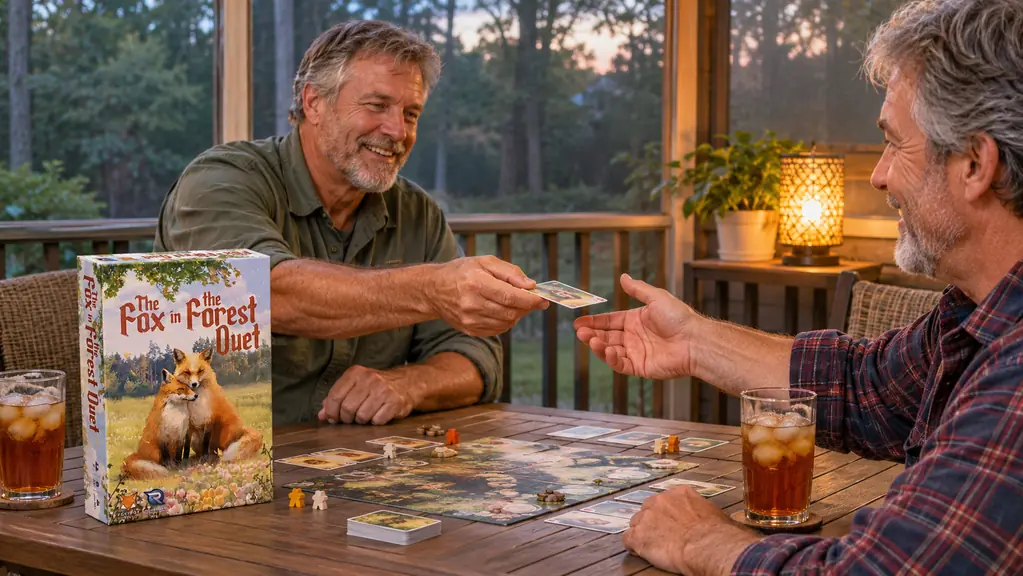
Where Lost Cities Wins
I want to be fair to Lost Cities, because it won in our house for years before the Duet showed up. The rules take about three minutes to explain. You play a card onto one of your expeditions or you discard it, and the numbers have to climb. That is nearly the whole game. My mother could play it. Walt's brother, who does not play games and says so loudly, played it. I taught it to my sister at a picnic table in a state park, sketching the expeditions on the back of a napkin with a ballpoint pen, and she beat me twice that afternoon before the sandwiches were gone. If you want something you can teach at the table without reading a rulebook twice and without anybody feeling dumb, it is the easier ask.
It is also the deeper game over many plays. The Duet is a puzzle you solve with another person, and after a dozen rounds you have a good feel for what it wants. Lost Cities has a slow arithmetic to it that keeps paying you back. When to start an expedition, when to cut your losses on one, when to hold a card you cannot use just to keep it out of your partner's hands. We have played it a hundred times and I still lose track of how many cards are left in the deck. That is a compliment, and I do not hand those out often.
And some couples genuinely want the contest. I have a friend who says a game without a winner is a chore, and she is not wrong for feeling that way. If the fun in your house comes from a real rivalry, from the small smugness of beating your husband by four points and mentioning it at breakfast, the Duet will feel soft to you. It is not a competition. It does not pretend to be one, and it does not have a mode where it becomes one.
If you would rather solve the evening together than win it
Fox in the Forest Duet is a two-player cooperative card game from Renegade Game Studios. Thirty minutes, one small box, and a shared problem on the table instead of a scoreboard between you.
Amazon Check Today's Price on Amazon →What Neither One Fixes
I want to be plain about this, because I have read enough cheerful product pages to last me the rest of my life. A card game is a card game. It gives you thirty minutes of something to do together that is not television, and it gives you something to talk about afterward while you are rinsing the cups. It does not fix a marriage, it does not turn a quiet man chatty, and it will not carry a whole relationship on its back. Walt is still the quiet one. He is just the quiet one who now tells me to hold a card back from across the table.
There were also evenings it did not work, and you should hear about those. If one of us is tired and cranky, a cooperative game can go sideways, because there is a fine line between we lost together and you played that badly and we both know it. Take a Thursday last February. Walt had spent the day under a heat pump and I had spent it on the phone with an insurance company about a claim that should have taken ten minutes. We got halfway to the gems, lost the round on a play I still believe was his fault, and did not say a word about it for two days. Now we laugh. Then, we put the box on the shelf and watched the news. Two-player card games are a tool for a good evening. They are not a repair kit for a bad one, and any page that tells you otherwise is selling you something else.
Walt is still the quiet one. He is just the quiet one who now tells me to hold a card back from across the table.
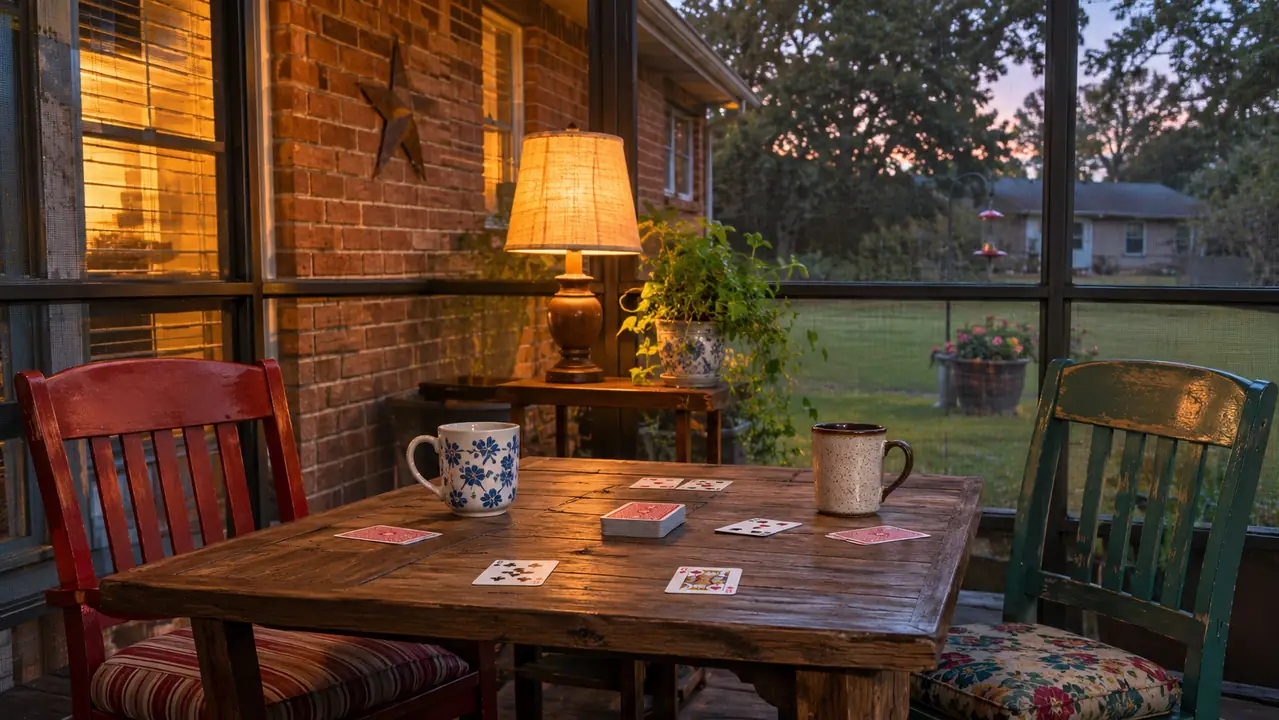
What a Round Actually Looks Like
A round of the Duet runs about thirty minutes, give or take a slow deal. You are playing tricks, and the object is gems, which the two of you collect together or fail to collect together. Each round hands out character powers that change what the round is asking of you, so the second play does not feel like a rerun of the first. The cards are small enough to hold in one hand, which matters when your hands are sixty-two years old and stiff on a cold morning. The gems sit in a little pile between you, and the size of that pile tells you how the round is going without anybody keeping score on paper. When it is over you know exactly how you did, because you either reached the gems you needed or you came up short. Then you shuffle and deal again, or you put it away, and either way the evening is not gone. Our first week with it we lost four rounds straight and could not have told you why. The fifth round we said every plan out loud before a card went down, and we won. I do not think that was a coincidence.
What surprised me is how much of the game happens in conversation rather than in the cards. In a competitive trick-taking game you keep your intentions to yourself, and half the skill is in the hiding. Here you are allowed, and mostly required, to say them out loud. What you are holding. What you are worried about. What you want your partner to save for later. Walt and I have had longer conversations over this box than over most restaurant dinners, and not one minute of it was about errands.
It travels well too, which matters more at our age than I expected. It goes in the bag for the porch, in the car for a weekend at our son's, and into the suitcase when we visit the grandchildren. There is no board, nothing to lose under the couch, and no score sheet to forget at home. The whole thing weighs less than a hardback book, which is the kind of detail you only appreciate after you have hauled a box of game boards across a parking lot.
Who Should Buy Which
Buy Fox in the Forest Duet if the two of you want an evening where you are on the same side. If your house already has enough contests, if the two of you spend your working days competing about something, or if one of you is quieter than the other and needs a reason to speak up, this is the one I would put on the table. It is also the better pick if you want something that fits into thirty minutes on a porch and does not require a rulebook refresher every time it comes out of the closet.
Buy Lost Cities, or keep the two-player games you already own, if what you want is a sharp contest with real depth. It is easier to teach, it rewards repeat play more, and it produces a winner at the end, which is the entire point for some couples. There is nothing wrong with wanting a winner. Plenty of marriages have kept a running score for thirty years and are perfectly happy. Neither box is the right answer for every household. Ours has room for both, and the Duet is the one that gets played when the evening needs a nudge rather than a match.
One small box, one shared problem, thirty minutes
If your evenings have gone quiet the way ours did, this is a low-stakes way to find out whether a cooperative card game gets the two of you talking again. Renegade Game Studios made it for exactly two players, and it fits on a kitchen table.
Amazon Check Today's Price on Amazon →