
Walt retired from heating and air work two years ago, and for a while our evenings had a shape I did not much like. He sat in the recliner with the television on. I sat on the other end of the couch with my phone. Around nine o'clock one of us would say something about the weather, and then we would go to bed.
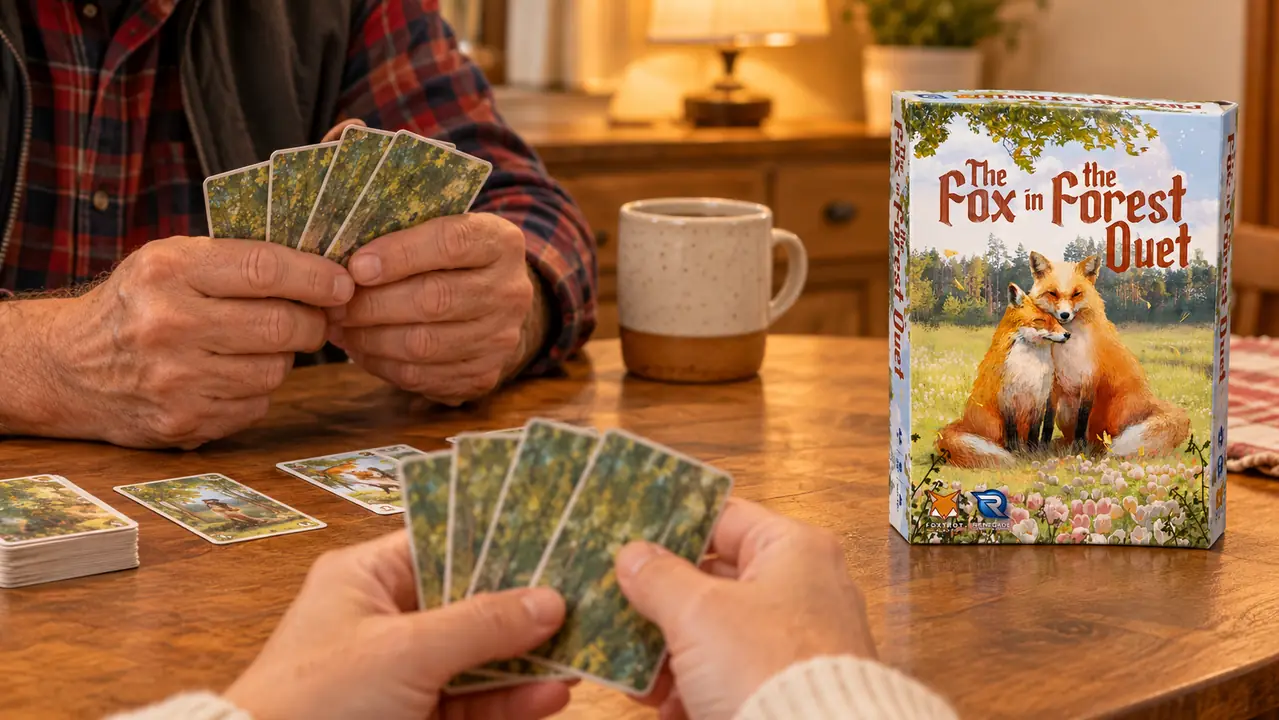
So I went looking for something small. Not a counselor, not a workbook with homework in it. Something we could set on the kitchen table on a Tuesday and pick at for half an hour. A friend at church mentioned a two-player card game called Fox in the Forest Duet, made by Renegade Game Studios, and I bought it mostly because it takes up no space and seemed harmless. Thirty-eight years in, you can get very efficient at running a household together and quietly forget the other part, and I was tired of being efficient.
I want to be clear that we were not in trouble. This is not a piece about a marriage on the rocks, and I am not qualified to write one. We had simply run out of things to say that were not about errands, the grandchildren, or whether the gutters needed cleaning again. Nobody warns you that retirement can make that worse rather than better, because now there is no work story to fall back on at supper. Whatever conversation we used to have about his day walked out the door the same week he did.
The short version is that we have played it most weeks since. The longer version is what it actually did for our evenings, what it did not do, and which of those two things matters more if you are thinking about buying it yourself.
Nobody was being polite. We were both trying to solve the same small problem, and somewhere in the middle of it he started talking.
If your evenings look like ours did, this is a small place to start
Fox in the Forest Duet is a cooperative card game built for exactly two players, about thirty minutes a round, from Renegade Game Studios. One box, one table, no argument about who won.
Amazon Check today's price on Amazon →Here is how it works, in plain terms. You and the person across the table are on the same side. You play cards in tricks, but the goal is not to beat your partner. It is to collect gems together, using the special abilities on the character cards, before your chances run out. Cooperative is the entire design, not a variant. Two players, ten and up, half an hour. If you have played trick-taking games before, you will recognize the shape of it right away. The difference is that a poor hand is not a loss, it is a problem the two of you work out together.
That last part mattered more than I expected, and it took me a while to understand why. Walt is a quiet man. He answers most questions with fine, and he has been that way since I met him, so it is not a retirement thing. In a game where one of us wins, he either lets me win, which I can feel happening, or he wins and then spends ten minutes apologizing for it. A cooperative game took all of that off the table. There was nothing to be polite about. He could play as hard as he wanted and it was still the two of us against the cards.
We played our first round on a Sunday and lost by a handful of gems. The second round we lost again. The third we squeaked through, and that rhythm of lose, lose, win by a hair turned out to be most of the appeal. Since then the game has moved around the house with the seasons. Summer, we take it out to the screened porch and play until the light goes. Winter, it lives on the kitchen table and we get a round in while the oven heats up. It all packs back into one small box, which is why it went with us to our daughter's house at Thanksgiving and got played on her coffee table after the dishes were done.
Now the honest part. The rulebook took us two evenings to get straight, and we played one rule wrong for the better part of a week before I looked it up. If you dislike card games on principle, this will not convert you. It is a game, not a conversation kit. It starts a conversation and it does not fix anything by itself, and I would not want you to buy it expecting otherwise. Thirty minutes is about right for us. If you want something to fill a whole evening, this is not that.
So who is it for. Couples who want a small shared thing rather than a project. Anyone with a partner like mine, who will not sit down for a workbook or a list of questions but will absolutely play cards. It says ten and up and I would not push it below that. Who should skip it: anyone after real depth, since the luck of the draw decides a fair number of rounds, and anyone whose spouse genuinely does not enjoy games. No box of cards changes that, and it is not fair to either of you to pretend otherwise.
What I'd Tell You If We Were Sitting at My Kitchen Table
I would tell you to pick a night and not make a production of it. Do not announce that you are having a connecting evening, because that will send Walt, and probably your husband too, straight back to the recliner. Just put the box on the table after supper and deal. Two rounds is plenty the first time, and losing both is fine. Keep the phones in the other room, which sounds like advice from a magazine and is still the single thing that helps most. And let him be quiet if he wants to be quiet. Walt talked more on the nights I stopped working so hard to draw him out.
I would also tell you not to keep score of who talks more. The point is not a breakthrough and it is not a repair. The point is that a Tuesday stops being only a Tuesday. We still have plenty of nights where we watch television and say nothing much, and that is fine too. This is one small thing that works in our house, and I think it works because it is small. If it turns out not to suit yours, you will know inside a week, and you can put it on the shelf without anybody's feelings getting hurt.
One box, one table, thirty minutes. That is the whole offer.
Fox in the Forest Duet from Renegade Game Studios. Two players, cooperative, ten and up, half an hour a round. A quiet evening with something to do besides the television.
Amazon See it on Amazon →