
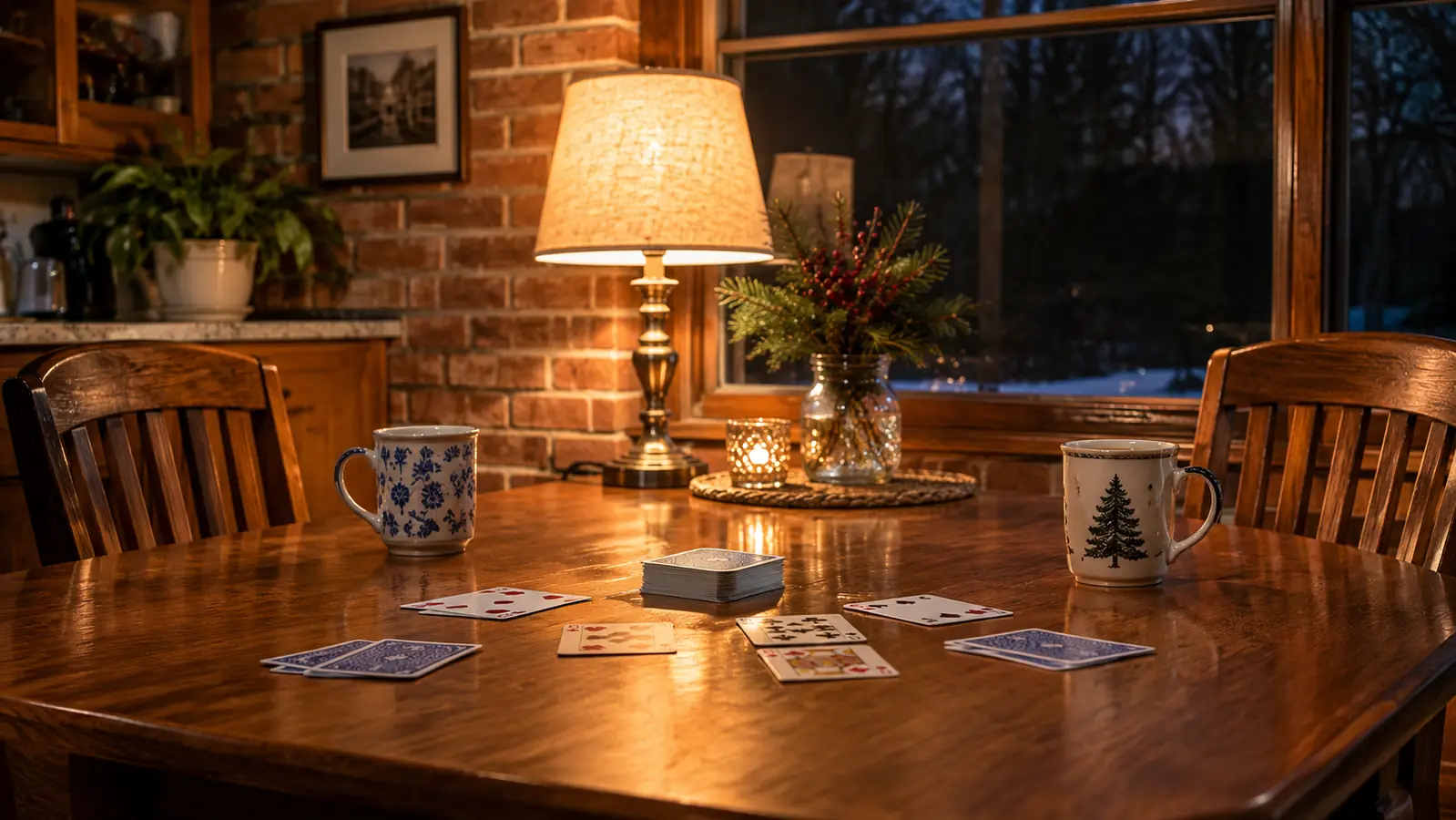
Walt and I have been married thirty-eight years, and last February I noticed we had run out of things to say between supper and the ten o'clock news. Not in a dramatic way. In a small, ordinary way. Same four subjects: the weather, the gutters, our daughter's flight times, the grandchildren. He said "fine" four times in eleven minutes and I stopped counting because I already knew the number.
So I went looking for something to put on that table that was not the television. Not a workbook. Not a deck of questions that makes a quiet man fold his arms and study the ceiling fan. A game. Something small enough to leave out on the counter and pick up on a Tuesday when neither of us had anything planned. That search is how we ended up with Fox in the Forest Duet from Renegade Game Studios, and it is also how we found out that the hard part is not the rules. The hard part is learning them together without one of you turning into the teacher.
Two players, thirty minutes, one shared job
Fox in the Forest Duet is a cooperative card game built for exactly two players, ages 10 and up, with about 30 minutes a round. You play tricks and collect gems together, so there is no scoreboard running between you and nobody has to be the loser.
Amazon See Fox in the Forest Duet on Amazon →Here is the order we do it in now. Five steps, and not one of them is about memorizing rules.
Step 1: Pick a game where you both have the same job
The first mistake I made was assuming any game would do. A competitive two-player game puts you across the table from each other, and in this house that means Walt plays to win and then goes quiet in a way that has nothing to do with the cards. Cooperative is a different animal. In Fox in the Forest Duet you are not trying to beat each other. You play cards into tricks, the tricks earn gems, and those gems are the goal you share. When a round goes badly, it goes badly for both of you at the same moment.
That sounds like a small thing. It is not. Thirty-eight years in, I can tell you that a shared loss is easier to talk about than one person's win. When we lose a round of this, the question is "what happened there?" instead of "why did you do that?" and the whole evening goes down a different road.
The theme is a fairy tale forest and each of you gets character powers that change what a card can do. That is the part that keeps Walt interested. He is not a man who enjoys a game of pure chance, and this one gives him something to chew on without handing him somebody to beat. The rules say cooperative play and special character abilities, and they mean it. You are solving a problem, not running a race.
The game also suits us on the practical side. It is designed specifically for two players, so there is no third hand to manage and no need to recruit anybody. The box says ages 10 and up. It says 30 minutes. In our house 30 minutes is honest, and I have never once looked up surprised at the clock.
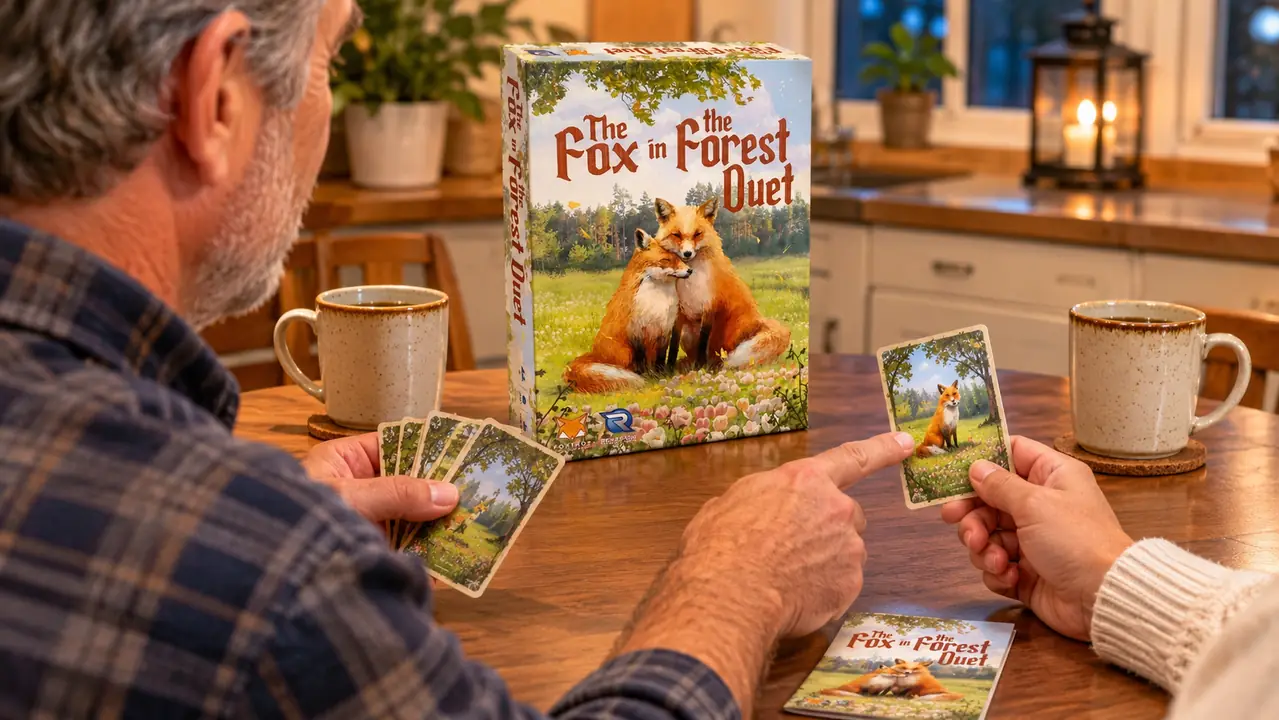
Step 2: Read the rules out loud, once, before anybody touches a card
This is where we went wrong the first night. Walt is a reader. He took the rule booklet to the recliner, read it end to end, and came back to the table with the whole thing in his head. Then he explained it to me. Within ten minutes I was not learning a game, I was being quizzed on one, and I had that feeling I used to get in a staff meeting when somebody flipped to page nine of a handout.
What works for us is dumber than that. One person reads the rules out loud, at the table, cards still in the box. The other person listens and interrupts. Then we swap halfway through so neither of us is the authority. It takes about eight minutes and it costs you the feeling that one of you is in charge of the evening.
One more note about that first read. The Renegade Game Studios booklet is small and the whole game is over in half an hour, so there is no excuse for a rule that nobody understands by the time you deal. If a paragraph is murky, we read it again before the first card, not in the middle of a hand when somebody is already cross.
The age range is 10 and up, and I would take that seriously in the other direction too. If you have a grandchild at the table who reads well, they can play this. Do not assume a card game is over a child's head because it looks like a children's game. Our grandchildren live out of state so we have not tested it that way, but the rules are simple enough that I would hand over the deck without a second thought.
Step 3: Play the first round with both hands face up on the table
Our first round is always a practice round and we do not count it. Both hands go face up where we can both see them. We are not playing to win. We are playing to find out what the cards actually do when they hit the table and what the character powers change.
That practice round is where the talking starts, and it starts because you cannot help it. You are looking at cards you would never have seen, and you have opinions about them. "Hold that low one." "I would not lead with that." Then the practice round ends, the hands go back to being private, and the habit is already there.
The first time we did this, the practice round lasted almost fifteen minutes because we kept stopping to look at things. That is fine. Nobody is timing you, and a slow first round saves you three confused ones.
Playing open also flattens the first loss. When we played closed on night one, we lost quickly and both of us quietly assumed the other one had done something foolish. When you can see both hands, you see the whole shape of what went wrong, and usually it is neither one of you. It is just the cards.
He said "fine" four times in eleven minutes that February. Twenty minutes into the first practice hand he was leaning over my cards telling me not to play the one I was about to play.

Step 4: Say your move out loud before you make it
This is the step that turns a card game into a conversation, and it is the one I would keep if I could only keep one. Before I lay a card down, I say what I am doing and why. "I am playing low because I want you to take this trick." Walt does the same. It feels silly for about four minutes, and then it stops feeling silly, because you are telling another person what you want and why you want it, over and over, for half an hour.
Walt's version of this took a while. He is a man who answers a question with "fine" and considers that a full report. Saying a move out loud was work for him at first. Now he narrates like a football announcer and I have to tell him to hurry up. I am not exaggerating. The last time we played he explained a two-card sequence to me with a hand gesture and a look.
One rule we added for ourselves: no apologizing for a card. If you play the wrong one, say what you were thinking, not sorry. An apology shuts a conversation down. An explanation opens it. That sounds like small etiquette and it changed the whole tone of our table.
You do not have to narrate forever. Do it for the first several rounds until the two of you have a shorthand, then let it drop to a word or a nod. The point was never the narration. The point was that he learned to say what he wanted at a table where nothing much was at stake, which turns out to be good practice for saying it in the kitchen on a Wednesday.
Step 5: Talk about the round after the cards are put away
We give this five minutes, and we do it before the box gets closed, because once the box is closed the evening is over and the television comes back on. Three questions. What went right. Where did we lose the thread. What would we try next time.
That third question is the one that carries. It looks forward, so nobody has to defend themselves, and it means you end the game planning something together instead of grading each other. It is also where the game does its quiet work. You start out talking about a card trick and you end up talking about how the two of you make decisions, which is not a conversation we were having in February.
I want to be plain about what this is. A card game is a card game. It does not fix a marriage and it does not stand in for a real conversation about something hard. If there is a serious thing sitting between you, this will not touch it, and I would not want you to think a box on the counter is a substitute for saying the difficult sentence out loud. What it does is put thirty minutes on the table where the two of you are on the same side of a small problem, talking, with your phones in the other room. That is all it does. In a quiet house, that is not nothing.
What Else Helps
A few things we learned the slower way. Play at the same table, not across the room, and put the phones somewhere you would have to stand up to reach. Keep the box out on the counter between games so it stays a Tuesday option and not an occasion. We play at the kitchen table in the winter and out on the screened porch once it warms up, and the change of room does more for the mood than any rule I could hand you.
Second, do not play past tired. Renegade Game Studios built this as a 30-minute game and there is no reason to start a third round at ten at night when one of you is already half gone. We stop after two. The last round of the night should be the one you remember, not the one you pushed through.
Third, let the quiet one deal. Walt deals. It gives him something to do with his hands while the talking starts, and it means the first minute of the game is not an awkward silence with two people looking at each other. Small thing. It helped.
And last. If one of you is resistant, do not sell it. Set it on the counter and play a round by yourself, or with a friend, where he can see it. Walt is far more willing to try something he discovered than something he was handed. That is not a card game lesson. That is a thirty-eight-year lesson.
If you want the longer version of what we think of the game itself, and how it stacks up next to other two-player card games, we have written about both. This page is only about learning it together, which is the part nobody tells you is the actual work.
Thirty minutes at the kitchen table, and neither of you is the teacher
Fox in the Forest Duet is a two-player cooperative card game from Renegade Game Studios. You play tricks, you collect gems together, and the only way either of you wins is if both of you do.
Amazon See It on Amazon →